


- Afhalen na 1 uur in een winkel met voorraad
- Gratis thuislevering in België vanaf € 30
- Ruim aanbod met 7 miljoen producten
- Afhalen na 1 uur in een winkel met voorraad
- Gratis thuislevering in België vanaf € 30
- Ruim aanbod met 7 miljoen producten





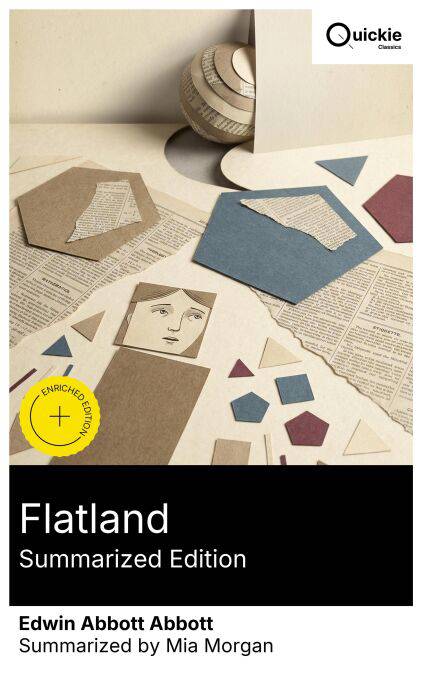
Flatland (Summarized Edition) E-BOOK
Enriched edition. Allegorical science fiction from a two-dimensional world - mathematical narrative, dimensional shifts, and Victorian social satire on class and gender.
Edwin Abbott Abbott
E-book | Engels
€ 1,99
+ 1 punten
Eenvoudig bestellen
Veilig betalen


Onmiddellijk geleverd via e-mail
Omschrijving
Flatland (1884) is a mathematico-philosophical satire narrated by A. Square, an inhabitant of a two‑dimensional world whose rigid social order maps neatly onto Victorian hierarchies. Through visits to Lineland and an irruption of Spaceland, Abbott fuses Euclidean exposition, parable, and speculative fiction to probe perception, orthodoxy, and the limits of inductive reason. The prose oscillates between pedagogical clarity—complete with geometric taxonomies and diagrams—and allegorical wit, situating the novella within the era's "scientific romance" alongside higher‑dimensional debates stirred by Riemann and popularized in periodicals. A classicist, theologian, and long-serving headmaster of the City of London School, Edwin Abbott Abbott coupled humanistic breadth with practical pedagogy. His educational treatises and liberal Anglican criticism reveal a reformer alert to entrenched dogma; his daily work teaching mathematics supplied the exact vocabulary of angles, polygons, and proof. Flatland emerges from this nexus: a classroom thought experiment sharpened into social critique, indicting gender prejudice and class stratification while modeling how imagination can overturn epistemic complacency. Readers of philosophy of science, mathematics, and Victorian studies will find this slim book inexhaustible: a lucid primer on dimensionality, a witty anatomy of ideology, and a cautionary tale about authority. Approach it as an elegant demonstration and enduring provocation.
Quickie Classics summarizes timeless works with precision, preserving the author's voice and keeping the prose clear, fast, and readable—distilled, never diluted. Enriched Edition extras: Introduction · Synopsis · Historical Context · Brief Analysis · 4 Reflection Q&As · Editorial Footnotes.
Quickie Classics summarizes timeless works with precision, preserving the author's voice and keeping the prose clear, fast, and readable—distilled, never diluted. Enriched Edition extras: Introduction · Synopsis · Historical Context · Brief Analysis · 4 Reflection Q&As · Editorial Footnotes.
Specificaties
Betrokkenen
- Auteur(s):
- Uitgeverij:
Inhoud
- Aantal bladzijden:
- 59
- Taal:
- Engels
Eigenschappen
- Productcode (EAN):
- 8596547882114
- Verschijningsdatum:
- 9/01/2026
- Uitvoering:
- E-book
- Beveiligd met:
- Digital watermarking
- Formaat:
- ePub


Alleen bij Standaard Boekhandel
+ 1 punten op je klantenkaart van Standaard Boekhandel
CADEAU

AANGERADEN


Beoordelingen
We publiceren alleen reviews die voldoen aan de voorwaarden voor reviews. Bekijk onze voorwaarden voor reviews.