


- Afhalen na 1 uur in een winkel met voorraad
- Gratis thuislevering in België vanaf € 30
- Ruim aanbod met 7 miljoen producten
- Afhalen na 1 uur in een winkel met voorraad
- Gratis thuislevering in België vanaf € 30
- Ruim aanbod met 7 miljoen producten





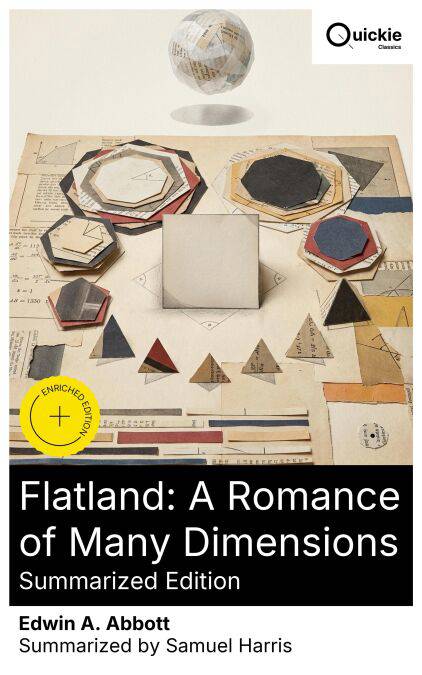
Flatland: A Romance of Many Dimensions (Summarized Edition) E-BOOK
Enriched edition. A Geometric Satire of Victorian Hierarchy and Dimensional Discovery, from Lineland to Spaceland and Pointland
Edwin A. Abbott
E-book | Engels
€ 0,49
Omschrijving
Flatland: A Romance of Many Dimensions (1884) follows A Square, a meticulous denizen of a plane, whose encounters with Lineland, Spaceland, and the ineffable Pointland expose both the possibilities and the peril of thinking beyond one's dimension. Written in the crisp idiom of Euclidean manuals yet edged with Swiftian satire, the narrative skewers Victorian hierarchies—class, gender, and intellectual dogma—while staging a lucid primer in dimensional analogy. The Illustrated Edition underscores Abbott's didactic architecture, rendering polygons, angles, and shadow-visions with clarity that illuminates the book's logical puzzles and philosophical provocation. Edwin A. Abbott—schoolmaster, theologian, and classicist—served as head of the City of London School, where he championed rigorous yet humane pedagogy. His training in classical rhetoric and biblical criticism sharpened his appetite for allegory and epistemic humility. Flatland distills those commitments, marrying mathematical instruction to a critique of authoritarian certainties, whether scholastic, scientific, or ecclesiastical. This edition suits readers of the history of ideas, mathematics educators, and lovers of speculative fiction alike. The diagrams make its dimensional metaphors immediately graspable, while the satire remains bracingly current. Approach it as a geometry lesson that becomes a moral education in intellectual hospitality.
Quickie Classics summarizes timeless works with precision, preserving the author's voice and keeping the prose clear, fast, and readable—distilled, never diluted. Enriched Edition extras: Introduction · Synopsis · Historical Context · Brief Analysis · 4 Reflection Q&As · Editorial Footnotes.
Quickie Classics summarizes timeless works with precision, preserving the author's voice and keeping the prose clear, fast, and readable—distilled, never diluted. Enriched Edition extras: Introduction · Synopsis · Historical Context · Brief Analysis · 4 Reflection Q&As · Editorial Footnotes.
Specificaties
Betrokkenen
- Auteur(s):
- Uitgeverij:
Inhoud
- Aantal bladzijden:
- 60
- Taal:
- Engels
Eigenschappen
- Productcode (EAN):
- 8596547877684
- Verschijningsdatum:
- 9/01/2026
- Uitvoering:
- E-book
- Beveiligd met:
- Digital watermarking
- Formaat:
- ePub


Alleen bij Standaard Boekhandel
Cadeau

AANGERADEN


Beoordelingen
We publiceren alleen reviews die voldoen aan de voorwaarden voor reviews. Bekijk onze voorwaarden voor reviews.