


- Afhalen na 1 uur in een winkel met voorraad
- Gratis thuislevering in België vanaf € 30
- Ruim aanbod met 7 miljoen producten
- Afhalen na 1 uur in een winkel met voorraad
- Gratis thuislevering in België vanaf € 30
- Ruim aanbod met 7 miljoen producten





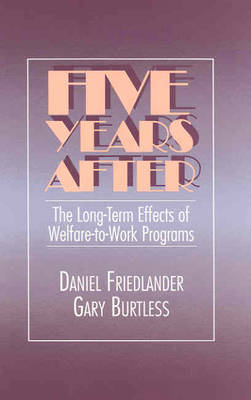
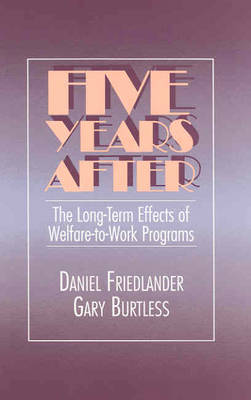
Five Years After
The Long-Term Effects of Welfare-To-Work Programs
Daniel Friedlander, Gary Burtless
Paperback | Engels
€ 49,45
+ 98 punten
Omschrijving
Friedlander and Burtless teach us why welfare reform will not be easy. Their sobering assessment of job training programs willenlighten a debate too often dominated by wishful thinking and political rhetoric. Look for their findings to be cited for many years to come. --Douglas Besharov, American Enterprise Institute A methodologically astute study that sheds considerable light on the potential for and limits to raising the employment and earnings of welfare recipients and provides benchmarks against which the impacts of later programs can be compared. --Journal of Economic Literature With welfare reforms tested in almost every state and plans for a comprehensive federal overall on the horizon, it is increasingly important for Americans to understand how policy changes are likely to affect the lives of welfare recipients. Five Years After tells the story of what happened to the welfare recipients who participated in the influential welfare-to-work experiments conducted by several states in the mid-1980s.The authors review the distinctive goals and procedures of evaluations performed in Arkansas, Baltimore, San Diego, and Virginia, and then examine five years of follow-up data to determine whether the initial positive impact on employment, earnings, and welfare costs held up over time. The results were surprisingly consistent. Low-cost programs that saved money by getting individuals into jobs quickly did little to reduce poverty in the long run. Only higher-cost educational programs enabled welfare recipients to hold down jobs successfully and stay off welfare. Five Years After ends speculation about the viability of the first generation of employment programs for welfare recipients, delineates the hard choices that must be made among competing approaches, and provides a well-documented foundation for building more comprehensive programs for the next generation. A sobering tale for welfare reformers of all political persuasions, this book poses a serious challenge to anyone who promises to end welfare dependency by cutting welfare budgets.
Specificaties
Betrokkenen
- Auteur(s):
- Uitgeverij:
Inhoud
- Aantal bladzijden:
- 242
- Taal:
- Engels
Eigenschappen
- Productcode (EAN):
- 9780871542670
- Verschijningsdatum:
- 28/06/1994
- Uitvoering:
- Paperback
- Formaat:
- Trade paperback (VS)
- Afmetingen:
- 154 mm x 229 mm
- Gewicht:
- 408 g


Alleen bij Standaard Boekhandel
+ 98 punten op je klantenkaart van Standaard Boekhandel
Cadeau

AANGERADEN


Beoordelingen
We publiceren alleen reviews die voldoen aan de voorwaarden voor reviews. Bekijk onze voorwaarden voor reviews.