


- Afhalen na 1 uur in een winkel met voorraad
- Gratis thuislevering in België vanaf € 30
- Ruim aanbod met 7 miljoen producten
- Afhalen na 1 uur in een winkel met voorraad
- Gratis thuislevering in België vanaf € 30
- Ruim aanbod met 7 miljoen producten





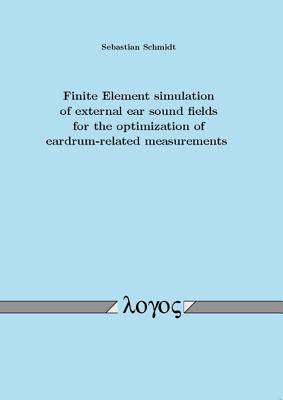
Finite Element Simulation of External Ear Sound Fields for the Optimization of Eardrum-Related Measurements
Sebastian Schmidt
Paperback | Engels
€ 85,45
+ 170 punten
Omschrijving
The sound pressure pT at the human eardrum has essential advantages as reference signal in audiological and psychoacoustical experiments. Unfortunately, precise pressure measurements very close to the tympanic membrane are difficult. In practice, the microphone has to be positioned at a certain distance from the eardrum. The measured pressure then has to be transformed to the eardrum. As a "classical" approach for the estimation of the necessary transfer function, an acoustical network model of the ear canal is developed from geometrical data of the canal (cross-sectional area function) which is in turn determined from measurements of its acoustical input impedance. Such methods, however, do not provide robust results. In this thesis, the concept of one-dimensional models of the ear canal is examined to find the origin of these errors. For this purpose, the sound field at the human external ear was analyzed using finite element models. Inside the canal, irregular three-dimensional structures occur that cannot be modelled accurately using classical one-dimensional network concepts. Upon these findings, an accurate, efficient and highly feasible method for the estimation of pT was developed. Equal-loudness level contours with reference to the eardrum pressure that were measured as pilot application of the new method are presented.
Specificaties
Betrokkenen
- Auteur(s):
- Uitgeverij:
Inhoud
- Aantal bladzijden:
- 153
- Taal:
- Engels
Eigenschappen
- Productcode (EAN):
- 9783832522629
- Verschijningsdatum:
- 31/08/2009
- Uitvoering:
- Paperback
- Formaat:
- Trade paperback (VS)
- Afmetingen:
- 145 mm x 211 mm
- Gewicht:
- 775 g


Alleen bij Standaard Boekhandel
+ 170 punten op je klantenkaart van Standaard Boekhandel
Wedstrijd


Beoordelingen
We publiceren alleen reviews die voldoen aan de voorwaarden voor reviews. Bekijk onze voorwaarden voor reviews.