


- Afhalen na 1 uur in een winkel met voorraad
- Gratis thuislevering in België vanaf € 30
- Ruim aanbod met 7 miljoen producten
- Afhalen na 1 uur in een winkel met voorraad
- Gratis thuislevering in België vanaf € 30
- Ruim aanbod met 7 miljoen producten





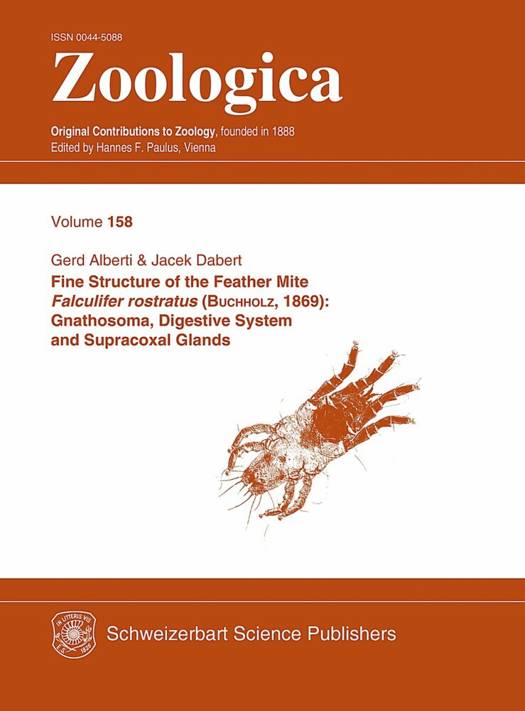
Fine Structure of the Feather Mite Falculifer rostratus (Buchholz 1869) (Acari, Falculiferidae)
Gnathosoma, Digestive System and Supracoxal Glands
Gerd Alberti, Jacek Dabert
€ 151,95
+ 303 punten
Eenvoudig bestellen
Veilig betalen


Gratis thuislevering vanaf € 30 (via bpost)
Gratis levering in je Standaard Boekhandel
Omschrijving
The authors present the first detailed and superbly illustrated study of the fine structure of the feather mite Falculifer rostratus. In particular its mouthparts are described and discussed under functional and comparative aspects. Falculifer rostratus was first described by the Greifswaldian Zoologist Reinhold Buchholz in 1869 (under the name Dermaleichus rostratus) from the plumage of the stock pigeon Columba oenas. F. rostratus later became the type species of the family Falculiferidae which comprises 14 genera and about 45 species living exclusively in the plumage of columbiform birds. These mites belong to a large assemblage of astigmatid mites (Astigmata, Acari) of more than 2500 known species, called feather mites. Although feather mites are observed on almost all bird species as putative paraphages or parasites, their biology and internal morphology is poorly known. In this context the bimorphism of males occurring in this species, the heteromorphs carrying sickle-shaped chelicerae (hence the generic name), is also discussed. For the first time, the fine structure of sensory organs of all gnathosomal parts of a mite is studied and described using scanning and transmission electron microscopy. The new findings advance our knowledge of one of the key-characters of Acari, the gnathosoma. A second contribution describes the digestive tract in full, revealing its organization into distinct parts characterised by distinct cell types. Occasionally, peculiar microsporidian parasites in the midgut of a female mite were discovered for the first time. Finally, the supracoxal glands, characteristic of astigmatid mites and previously only poorly understood in terms of their very complex structure and putative function, are thoroughly treated here. Numerous fine structural details are revealed, among them peculiar muscle attachment sites, microtubule-like elements in certain sensory organs, and very specific extrusion poles of the supracoxal glands; these new findings may be of general relevance to students of animal fine-structure. This volume is of great relevance to biologists studying arthropod structure, in particular to acarologists and arachnologists. However, also parasitologists, microbiologists, ornithologists and researchers interested in host-parasite-coevolution will find stimulating new data.
Specificaties
Betrokkenen
- Auteur(s):
- Uitgeverij:
Inhoud
- Taal:
- Engels
- Reeks:
- Reeksnummer:
- nr. 158
Eigenschappen
- Productcode (EAN):
- 9783510550456
- Uitvoering:
- Paperback
- Afmetingen:
- 230 mm x 310 mm
- Gewicht:
- 790 g


Alleen bij Standaard Boekhandel
+ 303 punten op je klantenkaart van Standaard Boekhandel
CADEAU

AANGERADEN


Beoordelingen
We publiceren alleen reviews die voldoen aan de voorwaarden voor reviews. Bekijk onze voorwaarden voor reviews.