


- Afhalen na 1 uur in een winkel met voorraad
- Gratis thuislevering in België vanaf € 30
- Ruim aanbod met 7 miljoen producten
- Afhalen na 1 uur in een winkel met voorraad
- Gratis thuislevering in België vanaf € 30
- Ruim aanbod met 7 miljoen producten





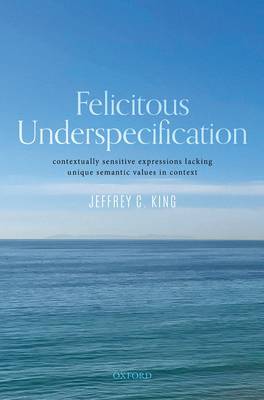
Felicitous Underspecification
Contextually Sensitive Expressions Lacking Unique Semantic Values in Context
Jeffrey C King
Hardcover | Engels
€ 140,45
+ 280 punten
Omschrijving
Felicitous uses of contextually sensitive expressions generally have unique semantic values in context. For example, a felicitous use of the singular pronoun 'she' generally has a single female as its unique semantic value in context. In the present work, Jeffrey C. King argues that contextually sensitive expressions have felicitous uses where they lack unique semantic values in context. He calls such uses instances of felicitous underspecification. In such cases, he says that the underspecified expression is associated with a range of candidate semantic values in context. King provides a rule for updating the Stalnakerian common ground when sentences containing felicitous underspecified expressions are uttered and accepted in a conversation. He also gives an account of the mechanism that associates the range of candidate semantic values in context with an underspecified expression. Sentences containing felicitous underspecified expressions can be embedded in various constructions. King considers the result of embedding such sentences under negation and verbs of propositional attitude. He also considers the question of why some uses of underspecified expressions are felicitous and others aren't. This investigation yields the notion of a context being appropriate for a sentence (LF), where a context is appropriate for a sentence containing an underspecified expression if the sentence is felicitous in that context. Finally, he considers some difficulties that arise in virtue of the fact that pronouns and demonstratives have some sorts of implications of uniqueness that clash with their being underspecified.
Specificaties
Betrokkenen
- Auteur(s):
- Uitgeverij:
Inhoud
- Aantal bladzijden:
- 176
- Taal:
- Engels
Eigenschappen
- Productcode (EAN):
- 9780192857057
- Verschijningsdatum:
- 21/03/2022
- Uitvoering:
- Hardcover
- Formaat:
- Genaaid
- Afmetingen:
- 144 mm x 207 mm
- Gewicht:
- 312 g


Alleen bij Standaard Boekhandel
+ 280 punten op je klantenkaart van Standaard Boekhandel
CADEAU


Beoordelingen
We publiceren alleen reviews die voldoen aan de voorwaarden voor reviews. Bekijk onze voorwaarden voor reviews.