


- Afhalen na 1 uur in een winkel met voorraad
- Gratis thuislevering in België vanaf € 30
- Ruim aanbod met 7 miljoen producten
- Afhalen na 1 uur in een winkel met voorraad
- Gratis thuislevering in België vanaf € 30
- Ruim aanbod met 7 miljoen producten




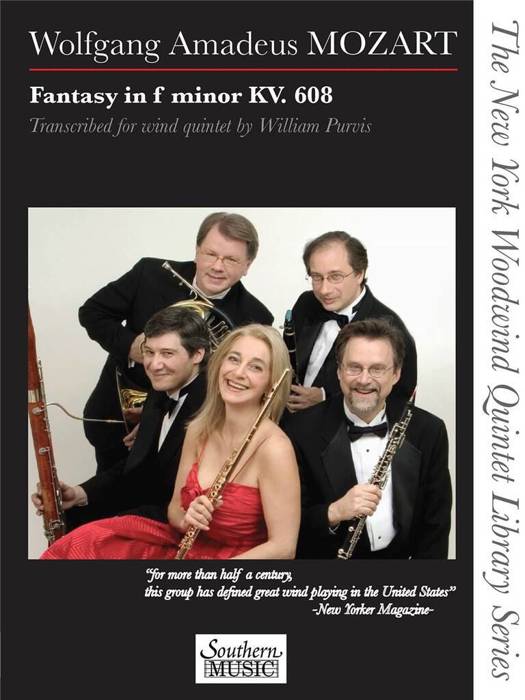
Fantasy in F Minor, K. 608
The New York Woodwind Quintet Library Series
Wolfgang Amadeus Moz
Paperback | Engels
€ 34,95
+ 69 punten
Omschrijving
(Southern Music Woodwind). These two extraordinary works of late Mozart, KV 594 and KV 608, were both composed to fulfill a commission for a memorial exhibit in Vienna, to be played in a "mechanical clock organ." The term "fantasy" or "fantasia" came to be affixed to these works later, and is more descriptive and less cumbersome than the term Mozart listed in his own catalogue, "Ein Stuke fur ein Orgelwerk in ein Uhr." They are also variously titled "Adagio und Allegro in f fur ein Orgelwerk" and "Allegro und Andante (Fantasie in f) fur eine Orgelwaltze." The first of these, composed between the monumental String Quintet in D and the Piano Concerto in Bb KV 595, is an A-B-A form, comprised of an f minor Adagio opening and closing, with a contrapuntal Allegro at its heart. KV 608 is more complicated, opening with an f minor section reminiscent of a French Overture, followed by a fugue in f minor, then an Andante aria, followed by a return to the opening and then a more complex version of the fugue. Despite the frustration that Mozart expressed (in a letter to Constanze) with the sound world of these mechanical devices, KV 594 and 608 are remarkable works which stand at an intersection, incorporating what he learned about counterpoint studying at the foot of Bach, while looking ahead to the emotional and harmonic poignancy of Schubert.
Specificaties
Betrokkenen
- Auteur(s):
- Uitgeverij:
Inhoud
- Aantal bladzijden:
- 20
- Taal:
- Engels
Eigenschappen
- Productcode (EAN):
- 9781581062052
- Verschijningsdatum:
- 1/01/2015
- Uitvoering:
- Paperback
- Formaat:
- Trade paperback (VS)
- Afmetingen:
- 221 mm x 300 mm
- Gewicht:
- 294 g


Alleen bij Standaard Boekhandel
+ 69 punten op je klantenkaart van Standaard Boekhandel
Wedstrijd


Beoordelingen
We publiceren alleen reviews die voldoen aan de voorwaarden voor reviews. Bekijk onze voorwaarden voor reviews.