



Je cadeautjes zeker op tijd in huis hebben voor de feestdagen? Kom langs in onze winkels en vind het perfecte geschenk!
- Afhalen na 1 uur in een winkel met voorraad
- Gratis thuislevering in België vanaf € 30
- Ruim aanbod met 7 miljoen producten
Je cadeautjes zeker op tijd in huis hebben voor de feestdagen? Kom langs in onze winkels en vind het perfecte geschenk!
- Afhalen na 1 uur in een winkel met voorraad
- Gratis thuislevering in België vanaf € 30
- Ruim aanbod met 7 miljoen producten





Omschrijving
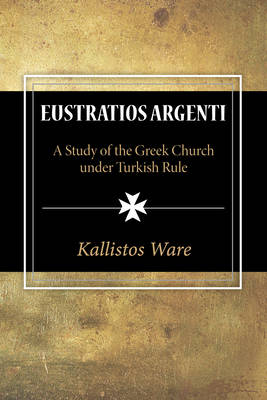
Endorsements: This is an important contribution to the virtually non-existent history of Orthodox theology of the ""post-Patristic"" age. Mr. Ware is right in stating in his introduction that ""four centuries of Turkish rule have left -- for good or evil -- a permanent mark upon the Greek Orthodox world"" and that ""without taking into account the way Greeks thought and felt under Turkish domination, and the way their theology developed between 1453 and 1821, it is all but impossible to understand the present condition of Greek Orthodoxy."" The book begins with an extremely valuable and well-documented chapter on the general state of Orthodoxy under Islam, with a special emphasis on the relations between the Greeks and the Latins. A modern ""ecumenicist"" will discover here many puzzling facts that could help him overcome some of the current oversimplifications. Chapter 2 gives us an exhaustive biography of Argenti and in chapter 3 through 4 the main theological problems debated by Argenti -- Baptism, Eucharist, purgatory, and papacy--are presented in a clear and penetrating way. Finally, a list of Argenti's writings and a bibliography crown this scholarly book. As said above, the importance of the book goes beyond the personal case of Argenti: it helps us understand the tragedy of Eastern Orthodoxy at the time when the West was reaching the climax of its religious and cultural development. ""Squeezed"" between Latin and Protestant influences, deprived of academic centers, Orthodox theology often surrendered to pressure. Mr. Ware's point is that in the case of Argenti it avoided such a surrender and preserved its tradition from deviations and errors. -- Alexander Schmemann, St. Vladimir Seminary Quarterly 9.2 (1965) About the Contributor(s): Kallistos Ware is an English bishop within the Eastern Orthodox Church under the Ecumenical Patriarchate of Constantinople and one of the best-known contemporary Eastern Orthodox theologians. From 1982 he has held the Titular Bishopric of Diokleia.
Specificaties
Betrokkenen
- Auteur(s):
- Uitgeverij:
Inhoud
- Aantal bladzijden:
- 208
- Taal:
- Engels
Eigenschappen
- Productcode (EAN):
- 9781625640826
- Verschijningsdatum:
- 8/05/2013
- Uitvoering:
- Paperback
- Formaat:
- Trade paperback (VS)
- Afmetingen:
- 140 mm x 213 mm
- Gewicht:
- 249 g


Alleen bij Standaard Boekhandel
+ 80 punten op je klantenkaart van Standaard Boekhandel
CADEAU


Beoordelingen
We publiceren alleen reviews die voldoen aan de voorwaarden voor reviews. Bekijk onze voorwaarden voor reviews.