


- Afhalen na 1 uur in een winkel met voorraad
- Gratis thuislevering in België vanaf € 30
- Ruim aanbod met 7 miljoen producten
- Afhalen na 1 uur in een winkel met voorraad
- Gratis thuislevering in België vanaf € 30
- Ruim aanbod met 7 miljoen producten





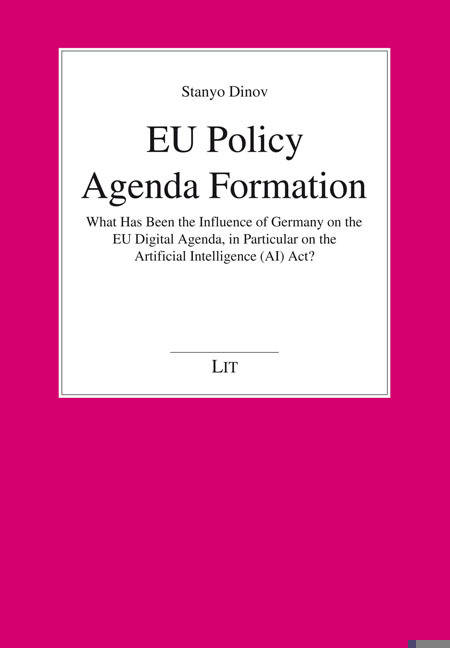
EU Policy Agenda Formation
What Has Been the Influence of Germany on the EU Digital Agenda, in Particular on the Artificial Intelligence (Ai) Act?
Stanyo Dinov
€ 19,95
+ 39 punten
Omschrijving
This book investigates the formation of the EU policy agenda, focusing on digitalisation. It presents theoretical approaches to agenda-setting and examines how they are shaped by multiple actors and factors across different governance levels. The study highlights the key role of EU Member States (MSs) in shaping the agenda through the EU institutions. Special emphasis is placed on the internal factors influencing national positions.
The research centres on Germany's influence on the EU Artificial Intelligence (AI) Act, exploring how its national AI priorities are formed through diverse actors and channels. The analysis evaluates Germany's evolving position, considering industry, social groups, international factors, and trade-offs, between social concerns and economic opportunities. The study discusses key AI-related concerns and future policy prospects.
The author holds a Doctor Juris from Heidelberg, multiple LLMs, and policy studies at Harvard and KU Leuven. He has worked for prestigious law firms, the European Commission, and EESC.
The research centres on Germany's influence on the EU Artificial Intelligence (AI) Act, exploring how its national AI priorities are formed through diverse actors and channels. The analysis evaluates Germany's evolving position, considering industry, social groups, international factors, and trade-offs, between social concerns and economic opportunities. The study discusses key AI-related concerns and future policy prospects.
The author holds a Doctor Juris from Heidelberg, multiple LLMs, and policy studies at Harvard and KU Leuven. He has worked for prestigious law firms, the European Commission, and EESC.
Specificaties
Betrokkenen
- Auteur(s):
- Uitgeverij:
Inhoud
- Aantal bladzijden:
- 72
- Taal:
- Engels
- Reeks:
Eigenschappen
- Productcode (EAN):
- 9783643918574
- Verschijningsdatum:
- 1/09/2025
- Uitvoering:
- Paperback
- Formaat:
- Trade paperback (VS)
- Afmetingen:
- 140 mm x 210 mm


Alleen bij Standaard Boekhandel
+ 39 punten op je klantenkaart van Standaard Boekhandel
Cadeau

AANGERADEN


Beoordelingen
We publiceren alleen reviews die voldoen aan de voorwaarden voor reviews. Bekijk onze voorwaarden voor reviews.