


- Afhalen na 1 uur in een winkel met voorraad
- Gratis thuislevering in België vanaf € 30
- Ruim aanbod met 7 miljoen producten
- Afhalen na 1 uur in een winkel met voorraad
- Gratis thuislevering in België vanaf € 30
- Ruim aanbod met 7 miljoen producten





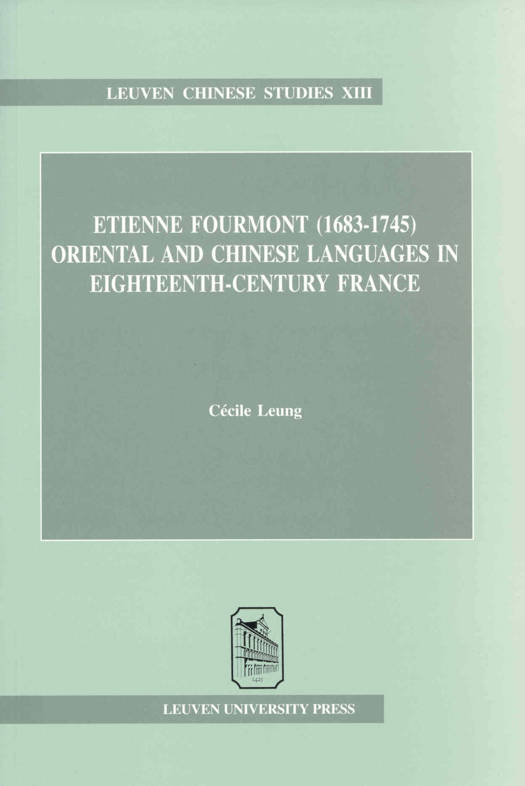
Etienne Fourmont (1683-1745)
Oriental and Chinese Languages in Eighteenth Century France
Cecile Leung
€ 27,00
+ 54 punten
Omschrijving
Fourmont was the first scholar in France to deal with Chinese matters. He started his career in the Académie des Inscriptions et Belles-Lettres as an Hebraist, but he left this discipline and turned to Chinese in 1711. At that time he met Arcadio Huang, a young French-speaking Chinese man in the Bibliothèque Nationale. Fourmont seized the opportunity to be introduced to Chinese. Huang taught him the pronunciation of Chinese syllables, and quite particularly, he introduced him to the 214 radicals. Fourmont's first book on the Chinese language, the Meditationes Sinicae , was published in 1737. His second work, Linguae Sinarum Mandarinicae Hieroglyphae , in 1742. Both these works are analyzed in detail in the present monograph. The presentation of the Chinese language in these publications was based on the Latin Grammar. One of the most fascinating points of Fourmont's studies was the way he dealt with the Chinese radicals. In the dictionaries, the Chinese characters are arranged according to a number of simple characters that enter obligatorily into more complex characters. In the course of the centuries the number of radicals varied from 60 to 600, but since 1615 it was settled at 214. This system of 214 radicals, which Fourmont saw in the dictionaries of the Bibliothèque Nationale, and which Huang taught him, was known to very few scholars in Europe. Fourmont's greatest feat was having 80,000 fine Chinese characters engraved in Paris for his many proposed dictionaries. He must have visited his engravers each day for many years to inspect and correct their work. The petits chinois , as these engravings were called, are still on display today at the Imprimerie Nationale in Paris.
Specificaties
Betrokkenen
- Auteur(s):
- Uitgeverij:
Inhoud
- Aantal bladzijden:
- 314
- Taal:
- Engels
- Reeks:
- Reeksnummer:
- nr. 13
Eigenschappen
- Productcode (EAN):
- 9789058672483
- Verschijningsdatum:
- 8/10/2002
- Uitvoering:
- Paperback
- Afmetingen:
- 160 mm x 240 mm
- Gewicht:
- 580 g


Alleen bij Standaard Boekhandel
+ 54 punten op je klantenkaart van Standaard Boekhandel
Cadeau

AANGERADEN


Beoordelingen
We publiceren alleen reviews die voldoen aan de voorwaarden voor reviews. Bekijk onze voorwaarden voor reviews.