


- Afhalen na 1 uur in een winkel met voorraad
- Gratis thuislevering in België vanaf € 30
- Ruim aanbod met 7 miljoen producten
- Afhalen na 1 uur in een winkel met voorraad
- Gratis thuislevering in België vanaf € 30
- Ruim aanbod met 7 miljoen producten





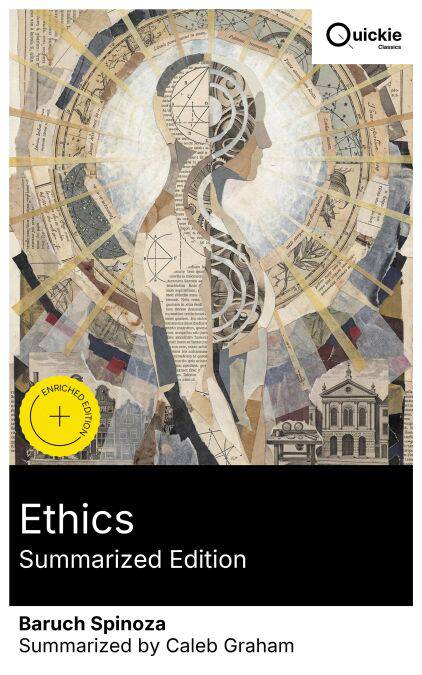
Ethics (Summarized Edition) E-BOOK
Enriched edition. Rationalism, Pantheism, and the Unity of Mind and Body in 17th-Century Metaphysics and Moral Philosophy
Baruch Spinoza
E-book | Engels
€ 1,99
+ 1 punten
Uitvoering
Omschrijving
Ethics (Complete Edition) advances Spinoza's geometric system through definitions, axioms, propositions, and scholia, unveiling a strict monism: one infinite substance, God or Nature, whose attributes—especially thought and extension—express all that is. From this follow modal dependence, mind–body parallelism, conatus, a taxonomy of the affects, and the passage from bondage to freedom culminating in the intellectual love of God. Composed in Euclidean rigor and framed by the Appendix to Part I and later prefaces, it stands within seventeenth‑century rationalism as a radical reply to Descartes and sectarian theology. Born in Amsterdam's Portuguese Jewish community and later placed under cherem, Spinoza lived as an independent lens grinder, corresponding with leading savants. His drive for clarity, civic peace, and freedom of philosophizing—announced in the Theologico‑Political Treatise—led him to ground ethics in metaphysical necessity and to write in careful Latin amid censorship. Refusing a Heidelberg chair and publishing the Ethics only posthumously in the Opera Posthuma, he pursued truth over reputation to the end. Readers of philosophy, theology, and the sciences will find an exacting but luminous guide to nature, mind, and virtue; the complete text rewards patience with a disciplined conception of freedom rooted in understanding.
Quickie Classics summarizes timeless works with precision, preserving the author's voice and keeping the prose clear, fast, and readable—distilled, never diluted. Enriched Edition extras: Introduction · Synopsis · Historical Context · Author Biography · Brief Analysis · 4 Reflection Q&As · Editorial Footnotes.
Quickie Classics summarizes timeless works with precision, preserving the author's voice and keeping the prose clear, fast, and readable—distilled, never diluted. Enriched Edition extras: Introduction · Synopsis · Historical Context · Author Biography · Brief Analysis · 4 Reflection Q&As · Editorial Footnotes.
Specificaties
Betrokkenen
- Auteur(s):
- Vertaler(s):
- Uitgeverij:
Inhoud
- Aantal bladzijden:
- 124
- Taal:
- Engels
Eigenschappen
- Productcode (EAN):
- 8596547879336
- Verschijningsdatum:
- 9/01/2026
- Uitvoering:
- E-book
- Beveiligd met:
- Digital watermarking
- Formaat:
- ePub


Alleen bij Standaard Boekhandel
+ 1 punten op je klantenkaart van Standaard Boekhandel
Cadeau

AANGERADEN


Beoordelingen
We publiceren alleen reviews die voldoen aan de voorwaarden voor reviews. Bekijk onze voorwaarden voor reviews.