


- Afhalen na 1 uur in een winkel met voorraad
- Gratis thuislevering in België vanaf € 30
- Ruim aanbod met 7 miljoen producten
- Afhalen na 1 uur in een winkel met voorraad
- Gratis thuislevering in België vanaf € 30
- Ruim aanbod met 7 miljoen producten




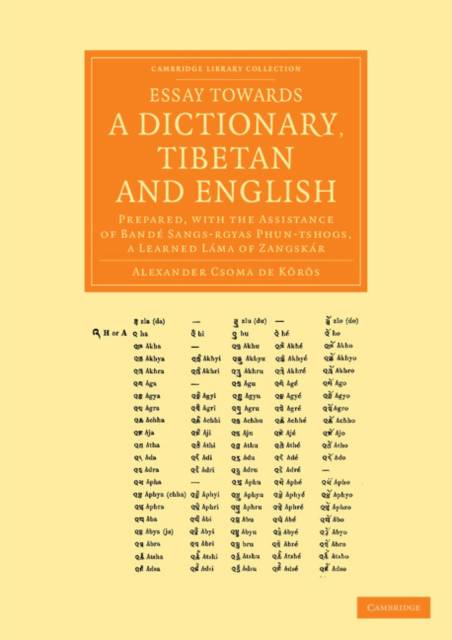
Essay Towards a Dictionary, Tibetan and English
Prepared, with the Assistance of Bandé Sangs-Rgyas Phun-Tshogs, a Learned Láma of Zangskár
Alexander Csoma de Kőrös
€ 111,45
+ 222 punten
Omschrijving
Tibetan comprises a cluster of Tibeto-Burman languages spoken across Central Asia. Its classical written form is a major Buddhist language. First published in 1834, this dictionary of Tibetan, believed to be the very first, was compiled by the Hungarian orientalist Kőrösi Csoma Sándor (c.1784-1842), who styled himself Alexander Csoma de Kőrös in English, and was considered to be the founder of the field of Tibetology. Containing over 20,000 entries with English translations, the dictionary was created during the author's travels in the East, during which he devoted himself to the study of the language. Remaining of great interest to linguists today, the dictionary begins with a useful guide to reading and understanding Tibetan words, with the value of each syllable given in Roman script. The entries themselves are arranged primarily under the language's thirty consonants, with irregular verb forms listed where necessary.
Specificaties
Betrokkenen
- Auteur(s):
- Uitgeverij:
Inhoud
- Aantal bladzijden:
- 378
- Taal:
- Engels
- Reeks:
Eigenschappen
- Productcode (EAN):
- 9781108056472
- Verschijningsdatum:
- 28/03/2013
- Uitvoering:
- Paperback
- Formaat:
- Trade paperback (VS)
- Afmetingen:
- 210 mm x 297 mm
- Gewicht:
- 902 g


Alleen bij Standaard Boekhandel
+ 222 punten op je klantenkaart van Standaard Boekhandel
Cadeau

AANGERADEN


Beoordelingen
We publiceren alleen reviews die voldoen aan de voorwaarden voor reviews. Bekijk onze voorwaarden voor reviews.