


- Afhalen na 1 uur in een winkel met voorraad
- Gratis thuislevering in België vanaf € 30
- Ruim aanbod met 7 miljoen producten
- Afhalen na 1 uur in een winkel met voorraad
- Gratis thuislevering in België vanaf € 30
- Ruim aanbod met 7 miljoen producten





€ 20,00
+ 40 punten
Omschrijving
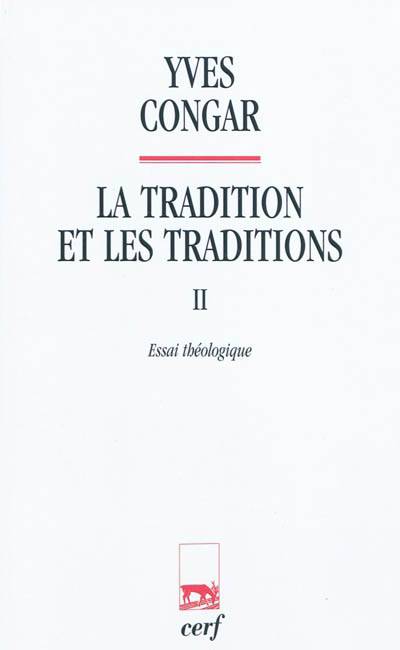
Dans ce second tome, Yves Congar aborde la question de la tradition d'un point de vue théologique. Il procède d'abord à une sorte d'inventaire et de classement. Puis il étudie successivement les aspects les plus décisifs de la question, sans prétendre constituer un traité didactique rigoureusement articulé. Il s'agit davantage d'un essai que d'une synthèse, d'une recherche prenant en compte les débats du moment, tant dans le cadre du dialogue oecuménique qu'à l'intérieur du monde catholique. La question de la Tradition et de ses rapports avec l'Écriture fut abordée par le second concile du Vatican dès sa première session. Ce second tome, paru en 1963, Yves Congar l'avait dédié « spécialement aux membres et aux présidents des Commissions qui, au compte du Conseil oecuménique des Églises, à New York, à Copenhague, ou à Rome, au compte du concile oecuménique du Vatican, oeuvrent aujourd'hui dans ce champ de travail, en vue de ce réavoisinement" des chrétiens que S.S. Jean XXIII indiquait comme la première étape à accomplir dans la voie de l'unit?.
--
In this second tome, Yves Congar approaches the question of Tradition from the theological point of view. Firstly he establishes a classified inventory, then goes on to study the most decisive aspects of the question successively, without claiming to constitute a rigorous didactic treatise. This is more of an essay than a synthesis more like research that takes into account current debates in the context of ecumenical dialogue and in the Catholic world. The question of Tradition and its relation with the Scriptures was discussed by the second Vatican council at the first session. Yves Congar dedicated this second tome, published in 1963, "specially to the members and presidents of the Commissions of the World Council of Churches, in New York, Copenhagen and Rome and to the Ecumenical Council of the Vatican, who work in this field today to achieve a rapprochement of Christians, which H.H John XXIII designated as being the first step on the road to unity"."
--
In this second tome, Yves Congar approaches the question of Tradition from the theological point of view. Firstly he establishes a classified inventory, then goes on to study the most decisive aspects of the question successively, without claiming to constitute a rigorous didactic treatise. This is more of an essay than a synthesis more like research that takes into account current debates in the context of ecumenical dialogue and in the Catholic world. The question of Tradition and its relation with the Scriptures was discussed by the second Vatican council at the first session. Yves Congar dedicated this second tome, published in 1963, "specially to the members and presidents of the Commissions of the World Council of Churches, in New York, Copenhagen and Rome and to the Ecumenical Council of the Vatican, who work in this field today to achieve a rapprochement of Christians, which H.H John XXIII designated as being the first step on the road to unity"."
Specificaties
Betrokkenen
- Auteur(s):
- Uitgeverij:
Inhoud
- Aantal bladzijden:
- 364
- Taal:
- Frans
- Reeks:
- Reeksnummer:
- nr. 2
Eigenschappen
- Productcode (EAN):
- 9782204092500
- Verschijningsdatum:
- 3/06/2010
- Uitvoering:
- Paperback
- Afmetingen:
- 140 mm x 220 mm
- Gewicht:
- 442 g


Alleen bij Standaard Boekhandel
+ 40 punten op je klantenkaart van Standaard Boekhandel

Beoordelingen
We publiceren alleen reviews die voldoen aan de voorwaarden voor reviews. Bekijk onze voorwaarden voor reviews.