



Bedankt voor het vertrouwen het afgelopen jaar! Om jou te bedanken bieden we GRATIS verzending (in België) aan op alles gedurende de hele maand januari.
- Afhalen na 1 uur in een winkel met voorraad
- In januari gratis thuislevering in België
- Ruim aanbod met 7 miljoen producten
Bedankt voor het vertrouwen het afgelopen jaar! Om jou te bedanken bieden we GRATIS verzending (in België) aan op alles gedurende de hele maand januari.
- Afhalen na 1 uur in een winkel met voorraad
- In januari gratis thuislevering in België
- Ruim aanbod met 7 miljoen producten





Omschrijving
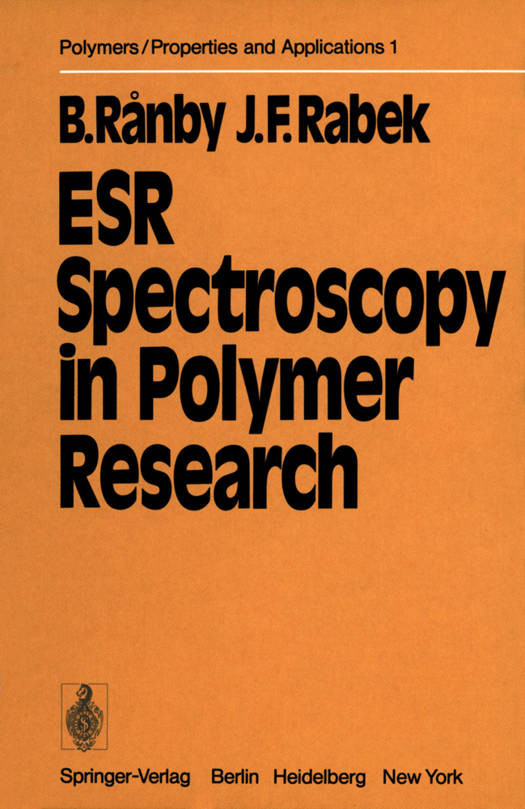
Thirty years ago, Zavoisky, in Moscow (USSR), reported the first successful experi- mental observations of the ESR phenomenon. Its application to polymer problems began about 20 years ago. ESR belongs to the most specific and useful methods in the study of polymer reactions. The main purpose of this book is to collect the present available information on the applications of electron spin resonance (ESR) spectroscopy in polymer research. The book has been written both for those who want an introduction to this field, and for those who are aheady familiar with ESR and are interested in application to polymers. Therefore, the fundamental principles of ESR spectroscopy are first out- lined, the experimental methods including computer applications are described in more detail, and the main emphasis is on the application of ESR methods to polymer problems. Many results obtained are only briefly treated for lack of space. The authors hope that this book will provide a useful source of information by giving a coherent treatment and extensive references to original papers, reviews, and discussions in monographs and books. In this way we hope to encourage polymer chemists, organic chemists, biochemists, physicists, and material scientists to apply ESR methods to their research problems.
Specificaties
Betrokkenen
- Auteur(s):
- Uitgeverij:
Inhoud
- Aantal bladzijden:
- 410
- Taal:
- Engels
- Reeks:
- Reeksnummer:
- nr. 1
Eigenschappen
- Productcode (EAN):
- 9783642666025
- Verschijningsdatum:
- 7/12/2011
- Uitvoering:
- Paperback
- Formaat:
- Trade paperback (VS)
- Afmetingen:
- 170 mm x 244 mm
- Gewicht:
- 675 g


Alleen bij Standaard Boekhandel
+ 279 punten op je klantenkaart van Standaard Boekhandel
SOLDEN


Beoordelingen
We publiceren alleen reviews die voldoen aan de voorwaarden voor reviews. Bekijk onze voorwaarden voor reviews.