


- Afhalen na 1 uur in een winkel met voorraad
- Gratis thuislevering in België vanaf € 30
- Ruim aanbod met 7 miljoen producten
- Afhalen na 1 uur in een winkel met voorraad
- Gratis thuislevering in België vanaf € 30
- Ruim aanbod met 7 miljoen producten





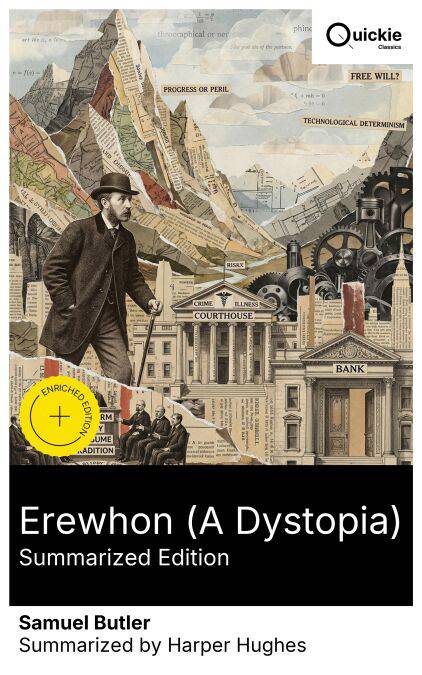
Erewhon (A Dystopia) (Summarized Edition) E-BOOK
Enriched edition. A satirical dystopia of Victorian society—philosophical parody, social criticism, and imaginative political commentary.
Samuel Butler
E-book | Engels
€ 1,99
+ 1 punten
Eenvoudig bestellen
Veilig betalen


Onmiddellijk geleverd via e-mail
Omschrijving
Erewhon (A Dystopia) stages a pseudo-travel narrative in which an unnamed explorer discovers a secluded society whose institutions invert Victorian common sense. Illness is punished, crime is treated, bankers preside over empty rites, and the deity Ydgrun (Conventionality) quietly governs conduct. In the 'Book of the Machines' Butler asks whether evolving technology might outstrip human control—anxieties voiced with Swiftian irony and measured prose. Situated between More's Utopia and later dystopias, the novel probes progress, free will, and responsibility amid post-Darwinian and industrial ferment. Samuel Butler, an Anglican clergyman's son, rejected ordination, farmed sheep in New Zealand, then returned to London as a painter and polemicist. The colonial sojourn supplied the mountainous threshold and outsider's gaze; engagement with Darwin prompted reflections on habit and heredity. Publishing Erewhon anonymously in 1872, and later extending it in Erewhon Revisited, he fused personal estrangement with philosophical dissent to probe the moral grammar of modernity. Recommended to readers of Swift, More, Huxley, and Orwell, this novel rewards anyone interested in Victorian culture, social theory, or the philosophy of technology. Its wit, lucid structure, and intellectual audacity anticipate today's debates about automation and biopolitics, making it a bracing, prescient study in the uses—and misuses—of progress.
Quickie Classics summarizes timeless works with precision, preserving the author's voice and keeping the prose clear, fast, and readable—distilled, never diluted. Enriched Edition extras: Introduction · Synopsis · Historical Context · Brief Analysis · 4 Reflection Q&As · Editorial Footnotes.
Quickie Classics summarizes timeless works with precision, preserving the author's voice and keeping the prose clear, fast, and readable—distilled, never diluted. Enriched Edition extras: Introduction · Synopsis · Historical Context · Brief Analysis · 4 Reflection Q&As · Editorial Footnotes.
Specificaties
Betrokkenen
- Auteur(s):
- Uitgeverij:
Inhoud
- Aantal bladzijden:
- 123
- Taal:
- Engels
Eigenschappen
- Productcode (EAN):
- 8596547882787
- Verschijningsdatum:
- 9/01/2026
- Uitvoering:
- E-book
- Beveiligd met:
- Digital watermarking
- Formaat:
- ePub



Alleen bij Standaard Boekhandel
+ 1 punten op je klantenkaart van Standaard Boekhandel
CADEAU

AANGERADEN


Beoordelingen
We publiceren alleen reviews die voldoen aan de voorwaarden voor reviews. Bekijk onze voorwaarden voor reviews.