


- Afhalen na 1 uur in een winkel met voorraad
- Gratis thuislevering in België vanaf € 30
- Ruim aanbod met 7 miljoen producten
- Afhalen na 1 uur in een winkel met voorraad
- Gratis thuislevering in België vanaf € 30
- Ruim aanbod met 7 miljoen producten





€ 4,49
+ 4 punten
Omschrijving
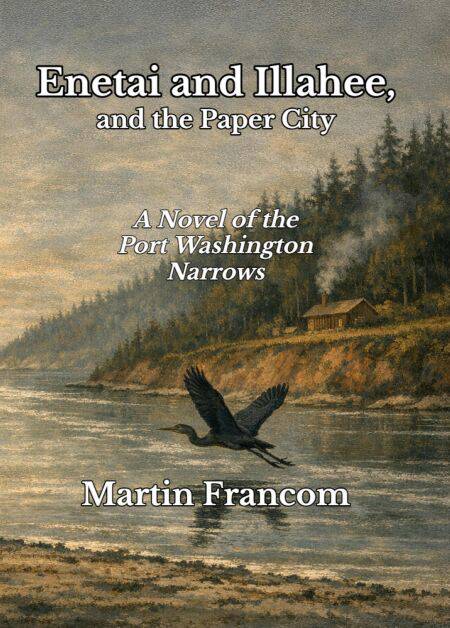
ENETAI AND ILLAHEE, AND THE PAPER CITY
A Novel of the Port Washington Narrows
Two shores. One channel. A world divided by a map.
In 1880, the Port Washington Narrows is a wilderness of emerald hemlock and treacherous, black-water currents. On the eastern ridge lies Illahee—the "place of home"—where Nathaniel Sargent, a Black pioneer born into slavery, carves a thriving orchard from the timber. Beside him, William Webster, a veteran of the U.S. Colored Infantry, drives a fence post four feet deep into the clay, anchoring a life he fought a war to earn.
Across the water sits Enetai—the "place across"—where the ancient logic of the tideflats is held in the memory of the Suquamish elder Piapach. Here, the history of the ground is recorded not in ink, but in cedar bark scrolls and the rhythmic cry of the blue heron.
But the 1890s bring the "Paper City."
William Bremer, a young immigrant with a surveyor's transit and a vision of industrial destiny, arrives in a Seattle real estate office. He sees the Narrows not as a home, but as a "Strategic Inevitability." With a single stroke of a pen, he plats a city where the trees still stand, turning the living ridge into a "Strategic Buffer" for a burgeoning Naval Yard.
What follows is the "Acoustic Horror" of progress. As the U.S. Navy moves to clear the land for the Puget Sound Naval Station, the homesteads of Illahee are condemned. The "Iron" of the shipyard begins its slow, relentless consumption of the "Green" of the ridge. The private lives of the pioneers are reduced to line-items in an Olympia archive, and a three-foot error in a fence line—the "Jog"—becomes the silent monument to a friendship caught in the gears of empire.
From the vibrating deck of the Mosquito Fleet steamer Dode to the haunted, tide-less silence of Horseshoe Lake, Enetai and Illahee, and the Paper City is a haunting "Gothic" chronicle of displacement and endurance. It is a story of the men who built the center, and the people who were pushed to the margins.
In this meticulously researched debut, Martin Francom explores the friction between the official record and the lived truth. It is a literary journey through a lost era of the Pacific Northwest—a time when the frontier was closed by a ledger, and a city was conjured from the mud.
History records the names of the builders. The ground remembers the touch of the displaced.
Perfect for readers of:
Ivan Doig and David Guterson: For fans of atmospheric, grounded Pacific Northwest historical fiction. The Overstory: For those who appreciate the intersection of human lives and the natural world. Hidden Histories: For readers seeking the untold stories of Black pioneers and Indigenous resilience in the American West.Enter the Narrows. Witness the clearing. Discover what the water kept.
Specificaties
Betrokkenen
- Auteur(s):
- Uitgeverij:
Inhoud
- Taal:
- Engels
Eigenschappen
- Productcode (EAN):
- 9798233923869
- Verschijningsdatum:
- 19/03/2026
- Uitvoering:
- E-book
- Formaat:
- ePub


Alleen bij Standaard Boekhandel
+ 4 punten op je klantenkaart van Standaard Boekhandel
CADEAU

AANGERADEN


Beoordelingen
We publiceren alleen reviews die voldoen aan de voorwaarden voor reviews. Bekijk onze voorwaarden voor reviews.