


- Afhalen na 1 uur in een winkel met voorraad
- Gratis thuislevering in België vanaf € 30
- Ruim aanbod met 7 miljoen producten
- Afhalen na 1 uur in een winkel met voorraad
- Gratis thuislevering in België vanaf € 30
- Ruim aanbod met 7 miljoen producten





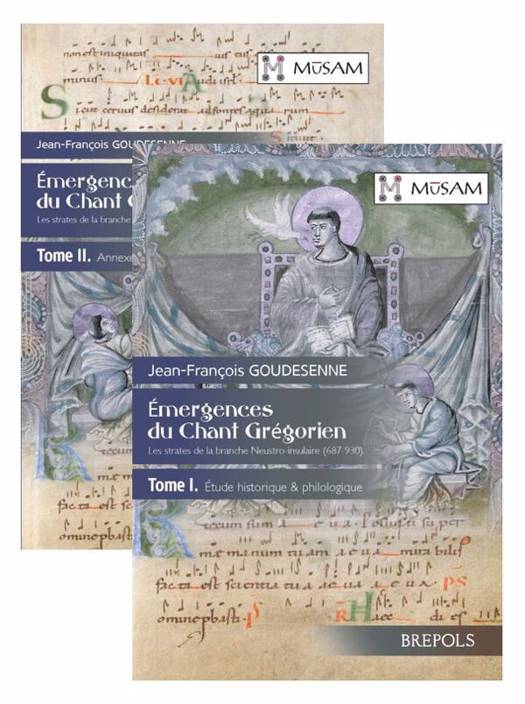
Émergences du Chant Grégorien : Les strates de la branche Neustro-insulaire (687-930)
Les Strates de la Branche Neustro-Insulaire (687-930)
Jean-François Goudesenne
€ 164,30
+ 328 punten
Eenvoudig bestellen
Veilig betalen


Gratis thuislevering vanaf € 30 (via bpost)
Gratis levering in je Standaard Boekhandel
Omschrijving
English Summary: Concerned with reconciling Gregorian erudition with liturgists' and philologists' works, Jean-Francois Goudesenne searches for the genesis of Gregorian chant, presenting the hypothesis of a first Frankish and Insular period that was rooted in the old Merovingian Neustria, refreshed by Irish and Anglo-Saxon monastic culture, and then associated with Carolingian centers in Piedmont and Lombardy. This hypothesis permits him to paint a new panoramic view of Gregorian Chant considered as plural and linked to other families, notably the Hispano-Gallican and Ambrosian traditions. Like Carolingian script, Gregorian chant developed like a mosaic, not from a unique center, but progressively from several matrices. Numerous oral interactions on writing, specific configurations of chant texts, and functions of liturgical manuscripts permit him to track different layers of chant and to free himself from the dogmas inherited from the neo-Lachmannian view held in nineteenth- and twentieth-century historiography of a unique original with two opposed branches, the Lotharingian and Alemanic from the Ottonian period. Thanks to the very rich resources of the Institut de Recherche et dHistoire des Textes and the programs he has led there for more than fifteenth years, Goudesenne revisits European cultural areas by inscribing the "emergence of Gregorian chant" as a progressive acculturation in a genealogical schema that is much more complex than a simple linear transmission. His slowly constructed position found through his study of a vast corpus of chant with a deep and long transmission in a wide variety of sources in Imperial space brings new approaches to the methods of Benedictine research of 1930-1960 as well as post-Cardine restitutions or the improbable "antiphoner of Charlemagne" of Levy, inspired by other predecessors, such as Treitler, Van der Werf, Bernard, Saulnier and Jeffery. Leaving aside the Gregorian myth and ambiguous concepts of author or text offers new perspectives- chant repertories reconsidered as transitional- between Roman, Insular, Frankish and Italic models, and more differentiated local uses- that a new history of Gregorian chant can no longer ignore. French Description: Soucieux de reconcilier l'erudition " gregorienne " avec les travaux des liturgistes et des philologues, Jean-Francois Goudesenne scrute dans la genese du chant " gregorien " l'hypothese d'une premiere phase franco-insulaire, enracinee dans l'ancienne Neustrie merovingienne, vivifiee par les apports monastiques irlandais et anglo-saxons, en lien a l'epoque carolingienne avec des foyers piemontais et lombards. Une hypothese qui permet de reconstruire la genese d'un gregorien decline au pluriel: comme la minuscule caroline, le cantus fut " fabrique " telle une mosaique, par etapes successives et non depuis un centre unique; une telle diversite, malgre tout unifiee, induit plusieurs matrices. Les multiples interferences de l'oralite sur l'ecriture, la nature specifique des textes chantes comme la fonction des manuscrits liturgiques permettent de deceler ses reecritures successives, degagees des dogmes herites d'une vision neo-lachmanienne de " l'original unique ", a deux branches opposees, dont la lotharingienne et l'alemano-germanique ont ete largement favorisees, depuis la periode ottonienne jusqu'a l'edition Vaticane. Grace aux ressources exceptionnelles de l'Institut de Recherche et d'Histoire des Textes et des programmes menes depuis plus de quinze annees, il revisite les aires culturelles europeennes en inscrivant " l'emergence gregorienne " dans une acculturation evolutive, selon un schema genealogique plus complexe qu'une simple transmission lineaire. Une posture lentement construite a partir d'un vaste corpus, desservie par un large panel de sources dans l'espace de l'Imperium et la profondeur de la transmission longue. Independant des methodes des entreprises solesmiennes de la premiere moitie du xxe siecle comme des restitutions de l'ecole post-cardinienne ou encore de cette theorie d'un improbable " antiphonaire de Charlemagne " de Levy, il s'inscrit plus volontiers dans la lignee des travaux de Treitler, Van der Werf, Bernard, Saulnier et Jeffery. L'abandon du " mythe gregorien ", des notions equivoques d'auteur et de texte ouvre de veritables perspectives pour ces repertoires " en transition " entre modeles romains, insulaires, francs et italiques, avecdes usages locaux plus differencies qu'une " nouvelle histoire " du cantus ne pourra plus ignorer.
Specificaties
Betrokkenen
- Auteur(s):
- Uitgeverij:
Inhoud
- Aantal bladzijden:
- 588
- Taal:
- Frans
- Reeks:
- Reeksnummer:
- nr. 1
Eigenschappen
- Productcode (EAN):
- 9782503579788
- Verschijningsdatum:
- 14/03/2019
- Formaat:
- Trade paperback (VS)
- Afmetingen:
- 216 mm x 280 mm
- Gewicht:
- 2400 g


Alleen bij Standaard Boekhandel
+ 328 punten op je klantenkaart van Standaard Boekhandel
CADEAU

AANGERADEN


Beoordelingen
We publiceren alleen reviews die voldoen aan de voorwaarden voor reviews. Bekijk onze voorwaarden voor reviews.