


- Afhalen na 1 uur in een winkel met voorraad
- Gratis thuislevering in België vanaf € 30
- Ruim aanbod met 7 miljoen producten
- Afhalen na 1 uur in een winkel met voorraad
- Gratis thuislevering in België vanaf € 30
- Ruim aanbod met 7 miljoen producten





€ 124,45
+ 248 punten
Uitvoering
Omschrijving
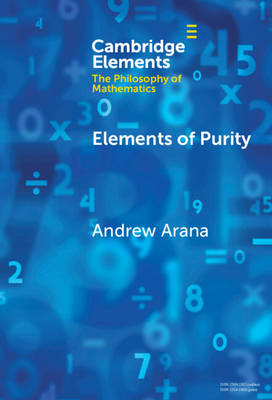
A proof of a theorem can be said to be pure if it draws only on what is 'close' or 'intrinsic' to that theorem. In this Element we will investigate the apparent preference for pure proofs that has persisted in mathematics since antiquity, alongside a competing preference for impurity. In Section 1, we present two examples of purity, from geometry and number theory. In Section 2, we give a brief history of purity in mathematics. In Section 3, we discuss several different types of purity, based on different measures of distance between theorem and proof. In Section 4 we discuss reasons for preferring pure proofs, for the varieties of purity constraints presented in Section 3. In Section 5 we conclude by reflecting briefly on purity as a preference for the local and how issues of translation intersect with the considerations we have raised throughout this work.
Specificaties
Betrokkenen
- Auteur(s):
- Uitgeverij:
Inhoud
- Aantal bladzijden:
- 84
- Taal:
- Engels
- Reeks:
Eigenschappen
- Productcode (EAN):
- 9781009539708
- Verschijningsdatum:
- 16/01/2025
- Uitvoering:
- Hardcover
- Formaat:
- Genaaid
- Afmetingen:
- 152 mm x 229 mm
- Gewicht:
- 285 g


Alleen bij Standaard Boekhandel
+ 248 punten op je klantenkaart van Standaard Boekhandel
Cadeau

AANGERADEN


Beoordelingen
We publiceren alleen reviews die voldoen aan de voorwaarden voor reviews. Bekijk onze voorwaarden voor reviews.