


- Afhalen na 1 uur in een winkel met voorraad
- Gratis thuislevering in België vanaf € 30
- Ruim aanbod met 7 miljoen producten
- Afhalen na 1 uur in een winkel met voorraad
- Gratis thuislevering in België vanaf € 30
- Ruim aanbod met 7 miljoen producten





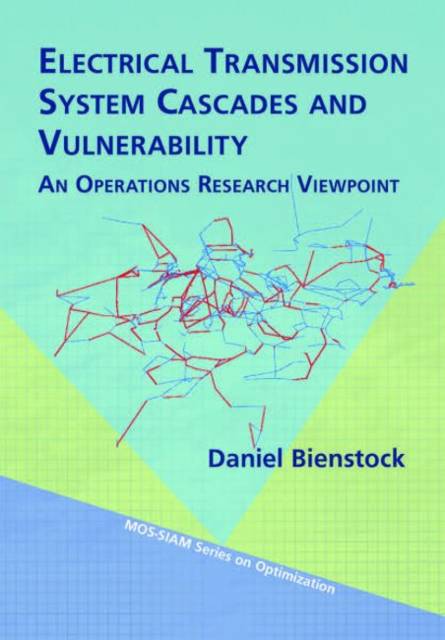
Electrical Transmission System Cascades and Vulnerability
An Operations Research Viewpoint
Daniel Bienstock
€ 92,45
+ 184 punten
Omschrijving
The power grid can be considered one of twentieth-century engineering's greatest achievements and, as grids and populations grow, robustness is a factor that planners must take into account. Since the underlying physics is mathematically complex, and modeling is complicated by lack of accurate data, power grid robustness is a complex problem. This book sheds light on this problem by introducing the engineering details of power grid operations from the basic to the detailed; describing how to use optimization and stochastic modeling, with special focus on the modeling of cascading failures and robustness; providing numerical examples that show 'how things work'; and detailing the application of a number of optimization theories to power grids. As a result, it will be useful to both operations researchers wishing to learn about power grids, as well as power engineers seeking an in-depth understanding of optimization methodologies and the rigorous thinking used in optimization.
Specificaties
Betrokkenen
- Auteur(s):
- Uitgeverij:
Inhoud
- Aantal bladzijden:
- 304
- Taal:
- Engels
- Reeks:
- Reeksnummer:
- nr. 22
Eigenschappen
- Productcode (EAN):
- 9781611974157
- Verschijningsdatum:
- 17/10/2016
- Uitvoering:
- Paperback
- Formaat:
- Trade paperback (VS)
- Afmetingen:
- 177 mm x 254 mm
- Gewicht:
- 639 g


Alleen bij Standaard Boekhandel
+ 184 punten op je klantenkaart van Standaard Boekhandel
Cadeau

AANGERADEN


Beoordelingen
We publiceren alleen reviews die voldoen aan de voorwaarden voor reviews. Bekijk onze voorwaarden voor reviews.