


- Afhalen na 1 uur in een winkel met voorraad
- Gratis thuislevering in België vanaf € 30
- Ruim aanbod met 7 miljoen producten
- Afhalen na 1 uur in een winkel met voorraad
- Gratis thuislevering in België vanaf € 30
- Ruim aanbod met 7 miljoen producten





Omschrijving
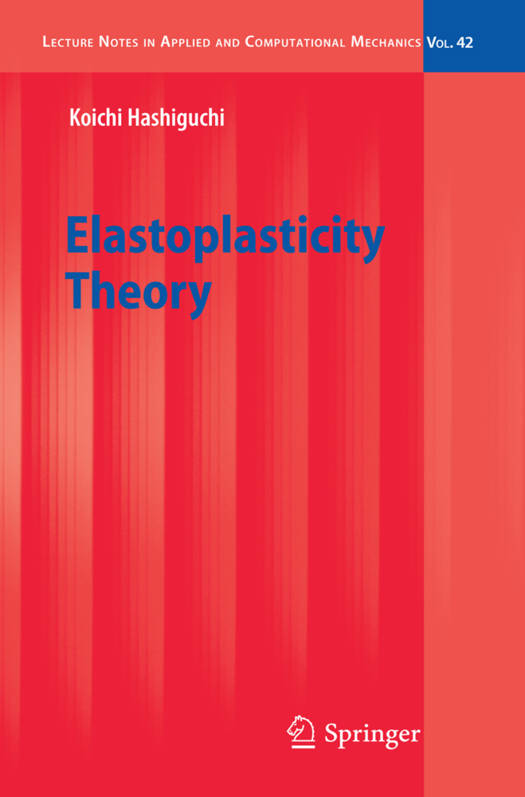
Contents Recent advancements in the performance of industrial products and structures are quite intense. Consequently, mechanical design of high accuracy is necessary to enhance their mechanical performance, strength and durability. The basis for their mechanical design can be provided through elastoplastic deformation analyses. For that reason, industrial engineers in the fields of mechanical, civil, architec- ral, aerospace engineering, etc. must learn pertinent knowledge relevant to elas- plasticity. Numerous books about elastoplasticity have been published since "Mathema- cal Theory of Plasticity", the notable book of R. Hill (1950), was written in the middle of the last century. That and similar books mainly address conventional plasticity models on the premise that the interior of a yield surface is an elastic domain. However, conventional plasticity models are applicable to the prediction of monotonic loading behavior, but are inapplicable to prediction of deformation behavior of machinery subjected to cyclic loading and civil or architectural str- tures subjected to earthquakes. Elastoplasticity has developed to predict defor- tion behavior under cyclic loading and non-proportional loading and to describe nonlocal, finite and rate-dependent deformation behavior.
Specificaties
Betrokkenen
- Auteur(s):
- Uitgeverij:
Inhoud
- Aantal bladzijden:
- 416
- Taal:
- Engels
- Reeks:
- Reeksnummer:
- nr. 42
Eigenschappen
- Productcode (EAN):
- 9783642101328
- Verschijningsdatum:
- 22/10/2010
- Uitvoering:
- Paperback
- Formaat:
- Trade paperback (VS)
- Afmetingen:
- 156 mm x 234 mm
- Gewicht:
- 603 g


Alleen bij Standaard Boekhandel
+ 363 punten op je klantenkaart van Standaard Boekhandel
CADEAU

AANGERADEN


Beoordelingen
We publiceren alleen reviews die voldoen aan de voorwaarden voor reviews. Bekijk onze voorwaarden voor reviews.