


- Afhalen na 1 uur in een winkel met voorraad
- Gratis thuislevering in België vanaf € 30
- Ruim aanbod met 7 miljoen producten
- Afhalen na 1 uur in een winkel met voorraad
- Gratis thuislevering in België vanaf € 30
- Ruim aanbod met 7 miljoen producten





€ 1,99
+ 1 punten
Uitvoering
Omschrijving
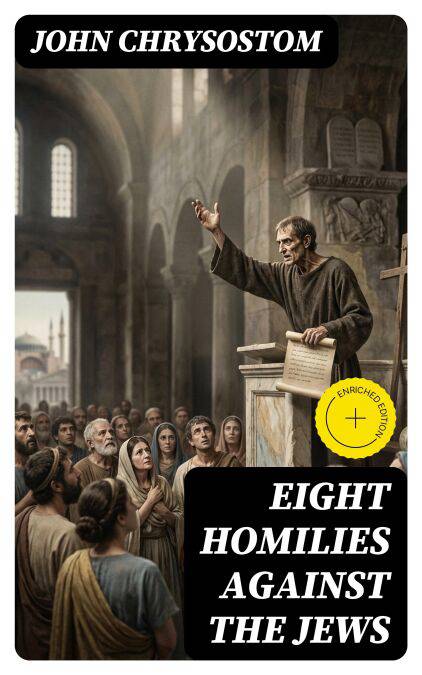
In "Eight Homilies Against the Jews," John Chrysostom, one of the most influential Church Fathers, presents a passionate and polemical treatise addressing the theological and social tensions between early Christians and Jews in the late fourth century. Written in a rhetorical style, rich with oratorical flourish, Chrysostom employs scriptural exegesis and vivid imagery to critique Jewish practices and beliefs, while simultaneously advocating for a distinct Christian identity. This work reflects the broader context of a post-Constantinian society where Christianity was becoming increasingly dominant, yet faced pressures to establish its theological legitimacy, often at the expense of its Jewish roots. John Chrysostom's background as a trained orator and his ascetic lifestyle significantly influenced his theological outlook. His role as Archbishop of Constantinople placed him at the center of ecclesiastical power and controversy, providing him with a platform to articulate his views on religious matters. Chrysostom's vehement critiques are informed by both his pastoral concerns for the Christian community and the sociopolitical climate of his time, ultimately reflecting his desire for conversion rather than merely condemnation. This work is essential for readers seeking to understand the complexities of early Christian-Jewish relations and the rhetorical strategies employed by Chrysostom. Scholars and lay readers alike will find value in delving into his intricate arguments, as the homilies expose the challenges of maintaining faith in an era of theological division, making it a compelling read for those interested in religious history, rhetoric, and the evolution of Christian thought.
In this enriched edition, we have carefully created added value for your reading experience:
- A comprehensive Introduction outlines these selected works' unifying features, themes, or stylistic evolutions.
- The Author Biography highlights personal milestones and literary influences that shape the entire body of writing.
- A Historical Context section situates the works in their broader era—social currents, cultural trends, and key events that underpin their creation.
- A concise Synopsis (Selection) offers an accessible overview of the included texts, helping readers navigate plotlines and main ideas without revealing critical twists.
- A unified Analysis examines recurring motifs and stylistic hallmarks across the collection, tying the stories together while spotlighting the different work's strengths.
- Reflection questions inspire deeper contemplation of the author's overarching message, inviting readers to draw connections among different texts and relate them to modern contexts.
- Lastly, our hand‐picked Memorable Quotes distill pivotal lines and turning points, serving as touchstones for the collection's central themes.
In this enriched edition, we have carefully created added value for your reading experience:
- A comprehensive Introduction outlines these selected works' unifying features, themes, or stylistic evolutions.
- The Author Biography highlights personal milestones and literary influences that shape the entire body of writing.
- A Historical Context section situates the works in their broader era—social currents, cultural trends, and key events that underpin their creation.
- A concise Synopsis (Selection) offers an accessible overview of the included texts, helping readers navigate plotlines and main ideas without revealing critical twists.
- A unified Analysis examines recurring motifs and stylistic hallmarks across the collection, tying the stories together while spotlighting the different work's strengths.
- Reflection questions inspire deeper contemplation of the author's overarching message, inviting readers to draw connections among different texts and relate them to modern contexts.
- Lastly, our hand‐picked Memorable Quotes distill pivotal lines and turning points, serving as touchstones for the collection's central themes.
Specificaties
Betrokkenen
- Auteur(s):
- Uitgeverij:
Inhoud
- Aantal bladzijden:
- 162
- Taal:
- Engels
Eigenschappen
- Productcode (EAN):
- 8596547019695
- Verschijningsdatum:
- 28/05/2022
- Uitvoering:
- E-book
- Beveiligd met:
- Digital watermarking
- Formaat:
- ePub


Alleen bij Standaard Boekhandel
+ 1 punten op je klantenkaart van Standaard Boekhandel
Cadeau

AANGERADEN


Beoordelingen
We publiceren alleen reviews die voldoen aan de voorwaarden voor reviews. Bekijk onze voorwaarden voor reviews.