


- Afhalen na 1 uur in een winkel met voorraad
- Gratis thuislevering in België vanaf € 30
- Ruim aanbod met 7 miljoen producten
- Afhalen na 1 uur in een winkel met voorraad
- Gratis thuislevering in België vanaf € 30
- Ruim aanbod met 7 miljoen producten





€ 54,45
+ 108 punten
Omschrijving
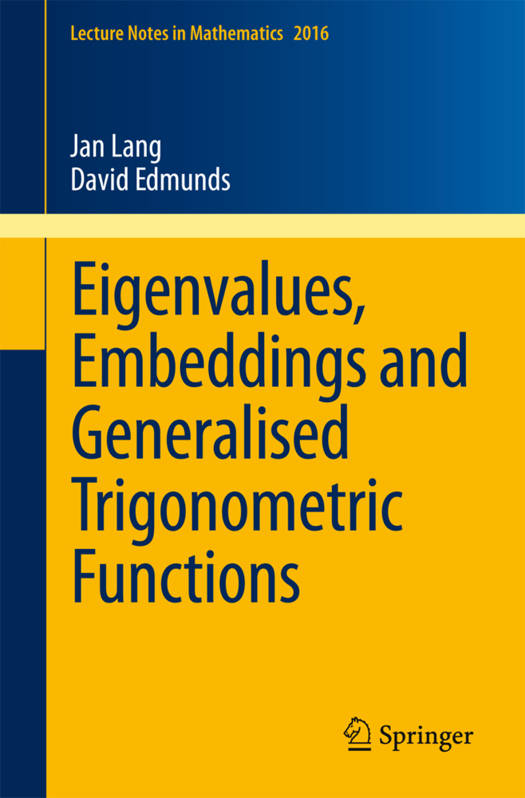
The main theme of the book is the study, from the standpoint of s-numbers, of integral operators of Hardy type and related Sobolev embeddings. In the theory of s-numbers the idea is to attach to every bounded linear map between Banach spaces a monotone decreasing sequence of non-negative numbers with a view to the classification of operators according to the way in which these numbers approach a limit: approximation numbers provide an especially important example of such numbers. The asymptotic behavior of the s-numbers of Hardy operators acting between Lebesgue spaces is determined here in a wide variety of cases. The proof methods involve the geometry of Banach spaces and generalized trigonometric functions; there are connections with the theory of the p-Laplacian.
Specificaties
Betrokkenen
- Auteur(s):
- Uitgeverij:
Inhoud
- Aantal bladzijden:
- 220
- Taal:
- Engels
- Reeks:
- Reeksnummer:
- nr. 2016
Eigenschappen
- Productcode (EAN):
- 9783642182679
- Verschijningsdatum:
- 23/03/2011
- Uitvoering:
- Paperback
- Formaat:
- Trade paperback (VS)
- Afmetingen:
- 155 mm x 234 mm
- Gewicht:
- 340 g


Alleen bij Standaard Boekhandel
+ 108 punten op je klantenkaart van Standaard Boekhandel
Cadeau

AANGERADEN


Beoordelingen
We publiceren alleen reviews die voldoen aan de voorwaarden voor reviews. Bekijk onze voorwaarden voor reviews.