


- Afhalen na 1 uur in een winkel met voorraad
- Gratis thuislevering in België vanaf € 30
- Ruim aanbod met 7 miljoen producten
- Afhalen na 1 uur in een winkel met voorraad
- Gratis thuislevering in België vanaf € 30
- Ruim aanbod met 7 miljoen producten





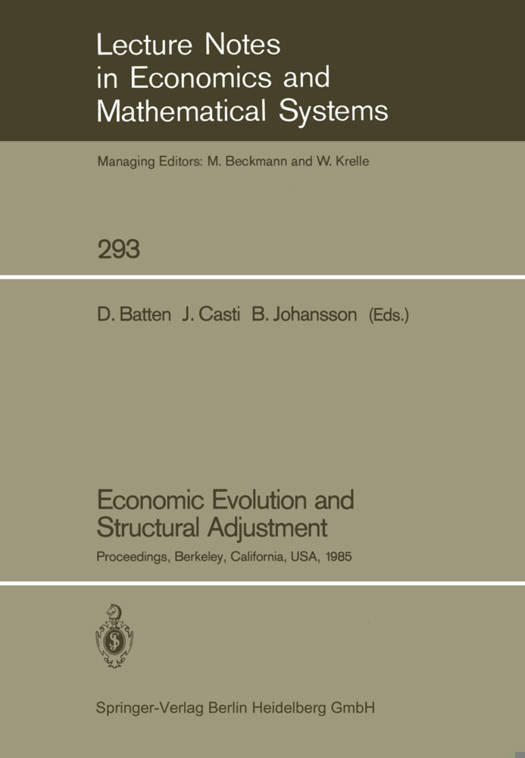
Economic Evolution and Structural Adjustment
Proceedings of Invited Sessions on Economic Evolution and Structural Change Held at the 5th International Conference on Mathematical Modelling at the University of California, Berkeley, California, USA July 29-31, 1985
David Batten
€ 53,45
+ 106 punten
Omschrijving
Since the beginning of the fifties, the ruling paradigm in the discipline of economics has been that of a competitive general equilibrium. Associated dynamic analyses have therefore been preoccupied with the stability of this equilibrium state, corresponding simply to studies of comparative statics. The need to permeate the boundaries of this paradigm in order to open up new pathways for genuine dynamic analysis is now pressing. The contributions contained in this volume spring from this very ambition. A growing circle of economists have recently been inspired by two distinct but complementary sources: (i) the pathbreaking work of Joseph Schumpeter, and (ii) recent contributions to physics, chemistry and theoretical biology. It turns out that problems which are firmly rooted in the economic discipline, such as innovation, technological change, business cycles and economic development, contain many clear parallels with phenomena from the natural sciences such as the slaving principle, adiabatic elimination and self-organization. In such dynamic worlds, adjustment processes and adaptive behaviour are modelled with the aid of the mathematical theory of nonlinear dynamical systems. The dynamics is defined for a much wider set of conditions or states than simply a set of competitive equilibria. A common objective is to study and classify ways in which the qualitative properties of each system change as the parameters describing the system vary.
Specificaties
Betrokkenen
- Auteur(s):
- Uitgeverij:
Inhoud
- Aantal bladzijden:
- 387
- Taal:
- Engels
- Reeks:
- Reeksnummer:
- nr. 293
Eigenschappen
- Productcode (EAN):
- 9783540181835
- Verschijningsdatum:
- 9/09/1987
- Uitvoering:
- Paperback
- Formaat:
- Trade paperback (VS)
- Afmetingen:
- 170 mm x 244 mm
- Gewicht:
- 625 g


Alleen bij Standaard Boekhandel
+ 106 punten op je klantenkaart van Standaard Boekhandel
AANGERADEN


Beoordelingen
We publiceren alleen reviews die voldoen aan de voorwaarden voor reviews. Bekijk onze voorwaarden voor reviews.