


- Afhalen na 1 uur in een winkel met voorraad
- Gratis thuislevering in België vanaf € 30
- Ruim aanbod met 7 miljoen producten
- Afhalen na 1 uur in een winkel met voorraad
- Gratis thuislevering in België vanaf € 30
- Ruim aanbod met 7 miljoen producten





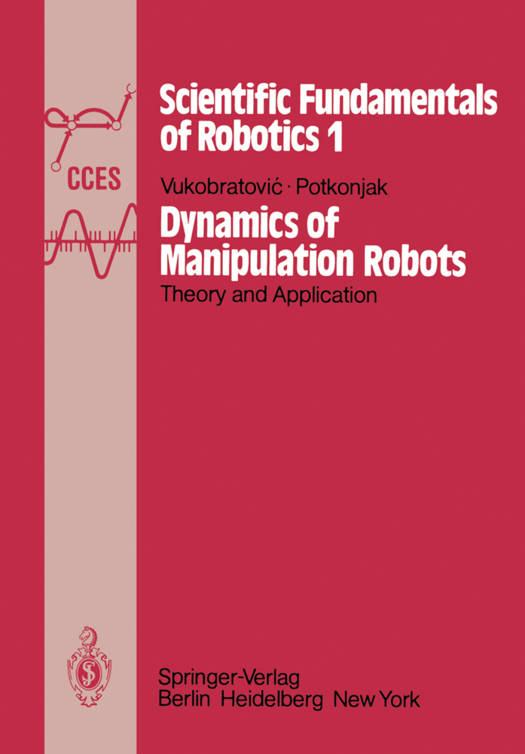
Dynamics of Manipulation Robots
Theory and Application
M Vukobratovic, V Potkonjak
Paperback | Engels | Communications and Control Engineering | Scientific Fundamentals of Robotics | nr. 1
€ 106,45
+ 212 punten
Omschrijving
This monograph represents the first book of the series entitled "SCI- ENTIFIC FUNDAMENTALS OF ROBOTICS". The aim of this monograph is to ap- proach the dynamics of active mechanisms from the standpoint of its application to the synthesis of complex motion and computer-aided de- sign of manipulation mechanisms with some optimal performances. The rapid development of a new class of mechanisms, which may be referred to as active mechanisms, contributed to their application in various environments (from underwater to cosmic) . Because of some specific fea- tures, these mechanisms require very careful description, both in a mechanical sense (kinematic and dynamic) and in the synthesis of algo- rithms for precise tracking of the above motion under insufficiently defined operating conditions. Having also in mind the need for a very fast (even real-time) calculation of system dynamics and for eliminating, in principle, the errors made when forming mathematical models "by hand" this monograph will primarily present methods for automatic for- mUlation of dynamic equations of motion of active spatial mechanisms. Apart from these computer-oriented methods, mention will be made of all those methods which have preceded the computer-oriented procedures, predominantly developed for different problems of rigid body dynamics. If we wish to systematically establish the origins of the scientific discipline, which could be called robot dynamics, we must recall some groups and individuals, who, by solving actual problems in the synthe- sis and control of artificial motion, have contributed to a gradual formation of this discipline.
Specificaties
Betrokkenen
- Auteur(s):
- Uitgeverij:
Inhoud
- Aantal bladzijden:
- 306
- Taal:
- Engels
- Reeks:
- Reeksnummer:
- nr. 1
Eigenschappen
- Productcode (EAN):
- 9783642818561
- Verschijningsdatum:
- 24/02/2012
- Uitvoering:
- Paperback
- Formaat:
- Trade paperback (VS)
- Afmetingen:
- 170 mm x 244 mm
- Gewicht:
- 517 g



Alleen bij Standaard Boekhandel
+ 212 punten op je klantenkaart van Standaard Boekhandel
CADEAU


Beoordelingen
We publiceren alleen reviews die voldoen aan de voorwaarden voor reviews. Bekijk onze voorwaarden voor reviews.