


- Afhalen na 1 uur in een winkel met voorraad
- Gratis thuislevering in België vanaf € 30
- Ruim aanbod met 7 miljoen producten
- Afhalen na 1 uur in een winkel met voorraad
- Gratis thuislevering in België vanaf € 30
- Ruim aanbod met 7 miljoen producten





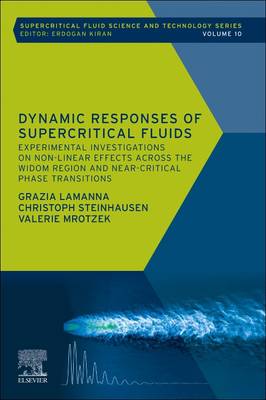
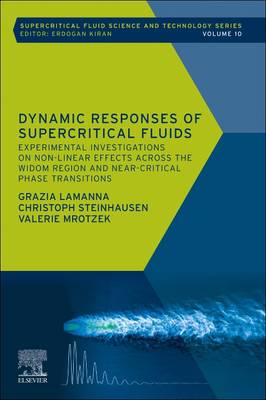
Dynamic Responses of Supercritical Fluids
Experimental Investigations on Non-Linear Effects Across the Widom Region and Near-Critical Phase Transitions
Grazia Lamanna, Christoph Steinhausen, Valerie Mrotzek
€ 309,95
+ 619 punten
Omschrijving
Dynamic Responses of Supercritical Fluids: Experimental Investigations on Non-Linear Effects Across the Widom Region and Near-Critical Phase Transitions provides comprehensive information on the experimental techniques that can be used to measure the dynamic responses of near-to supercritical fluids, along with an overview of the related physical phenomena involved. This book is ideal for applied physicists, engineers, and graduate and doctoral students in chemical engineering, process engineering, and aerospace engineering.
At the transition from liquid or gaseous fluid states into the supercritical regime, the macroscopic fluid response functions experience maxima, which results in a non-linear coupling between small perturbations in pressure and temperature and compressible flow dynamics. By applying laser-induced thermal acoustics, also known as laser-induced (transient) grating spectroscopy, the fluid response to an acoustic, pressure, and thermal perturbation can be investigated. Specifically, speed of sound, thermal diffusivities, and acoustic damping rates, are measured. And, by applying thermodynamic model, the latter are used to determine volume viscosities at near- to supercritical fluid states. Finally, by applying polarized Mie scattering, insights on the type of phase transitions can be inferred together with quantitative data on the average size, and droplet size distribution can be obtained.Specificaties
Betrokkenen
- Auteur(s):
- Uitgeverij:
Inhoud
- Aantal bladzijden:
- 352
- Taal:
- Engels
- Reeks:
Eigenschappen
- Productcode (EAN):
- 9780443136375
- Verschijningsdatum:
- 01/10/2026
- Uitvoering:
- Paperback
- Formaat:
- Trade paperback (VS)
- Afmetingen:
- 190 mm x 235 mm


Alleen bij Standaard Boekhandel
+ 619 punten op je klantenkaart van Standaard Boekhandel
Cadeau

AANGERADEN


Beoordelingen
We publiceren alleen reviews die voldoen aan de voorwaarden voor reviews. Bekijk onze voorwaarden voor reviews.