


- Afhalen na 1 uur in een winkel met voorraad
- Gratis thuislevering in België vanaf € 30
- Ruim aanbod met 7 miljoen producten
- Afhalen na 1 uur in een winkel met voorraad
- Gratis thuislevering in België vanaf € 30
- Ruim aanbod met 7 miljoen producten





Omschrijving
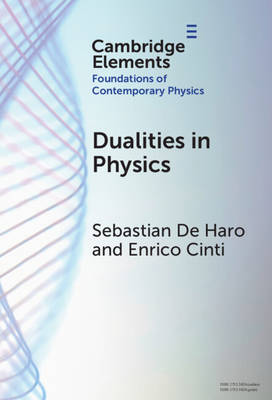
For more than half a century, dualities have been at the heart of modern physics. From quantum mechanics to statistical mechanics, condensed matter physics, quantum field theory and quantum gravity, dualities have proven useful in solving problems that are otherwise quite intractable. Being surprising and unexpected, dualities have been taken to raise philosophical questions about the nature and formulation of scientific theories, scientific realism, emergence, symmetries, explanation, understanding, and theory construction. This Element discusses what dualities are, gives a selection of examples, explores the themes and roles that make dualities interesting, and highlights their most salient types. It aims to be an entry point into discussions of dualities in both physics and philosophy. The philosophical discussion emphasises three main topics: whether duals are theoretically equivalent, the view of scientific theories that is suggested by dualities (namely, a geometric view of theories) and the compatibility between duality and emergence.
Specificaties
Betrokkenen
- Auteur(s):
- Uitgeverij:
Inhoud
- Aantal bladzijden:
- 75
- Taal:
- Engels
- Reeks:
Eigenschappen
- Productcode (EAN):
- 9781009663168
- Verschijningsdatum:
- 4/06/2026
- Uitvoering:
- Hardcover
- Formaat:
- Genaaid


Alleen bij Standaard Boekhandel
+ 158 punten op je klantenkaart van Standaard Boekhandel
Cadeau

AANGERADEN


Beoordelingen
We publiceren alleen reviews die voldoen aan de voorwaarden voor reviews. Bekijk onze voorwaarden voor reviews.