


- Afhalen na 1 uur in een winkel met voorraad
- Gratis thuislevering in België vanaf € 30
- Ruim aanbod met 7 miljoen producten
- Afhalen na 1 uur in een winkel met voorraad
- Gratis thuislevering in België vanaf € 30
- Ruim aanbod met 7 miljoen producten





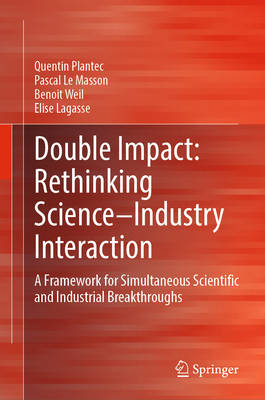
Double Impact: Rethinking Science-Industry Interaction
A Framework for Simultaneous Scientific and Industrial Breakthroughs
Quentin Plantec, Pascal Le Masson, Benoit Weil, Elise Lagasse
Hardcover | Engels
€ 119,45
+ 238 punten
Eenvoudig bestellen
Veilig betalen


Gratis thuislevering vanaf € 30 (via bpost)
Gratis levering in je Standaard Boekhandel
Omschrijving
This book explores how science-industry collaboration drives innovation and breakthrough discoveries. To tackle the grand challenges of our time--from climate change to health crises and technological transitions--we need both novel scientific knowledge and radical innovation. Yet these two goals are often seen as a linear sequence: first science, then its application in industry. This book challenges that view by introducing the concept of double impact simultaneous coupling, a groundbreaking model showing how scientific discovery and disruptive innovation can emerge together through well-structured collaboration. Drawing on eight years of research--including analyses of historical breakthroughs, Nobel Prize-winning projects, and over engineering doctoral theses--the authors reveal how industry can be more than a user of science: it can be a fertile ground for creating it. Combining clear theoretical models, vivid historical and contemporary case studies, and robust empirical evidence, this book offers a practical and conceptual toolkit for academic and corporate scientists, innovation leaders, policymakers, and academic institutions. It demonstrates how aligned yet independent exploration and structured knowledge exchange between science and industry can unlock extraordinary results. Whether you manage a research lab, design R&D policy, or aim to transform science-based industrial strategy, this book is an essential guide to building more ambitious, balanced, and impactful science-industry collaborations.
Specificaties
Betrokkenen
- Auteur(s):
- Uitgeverij:
Inhoud
- Aantal bladzijden:
- 223
- Taal:
- Engels
Eigenschappen
- Productcode (EAN):
- 9783032295194
- Verschijningsdatum:
- 23/07/2026
- Uitvoering:
- Hardcover
- Formaat:
- Genaaid
- Afmetingen:
- 155 mm x 235 mm


Alleen bij Standaard Boekhandel
+ 238 punten op je klantenkaart van Standaard Boekhandel
CADEAU

AANGERADEN


Beoordelingen
We publiceren alleen reviews die voldoen aan de voorwaarden voor reviews. Bekijk onze voorwaarden voor reviews.