


- Afhalen na 1 uur in een winkel met voorraad
- Gratis thuislevering in België vanaf € 30
- Ruim aanbod met 7 miljoen producten
- Afhalen na 1 uur in een winkel met voorraad
- Gratis thuislevering in België vanaf € 30
- Ruim aanbod met 7 miljoen producten





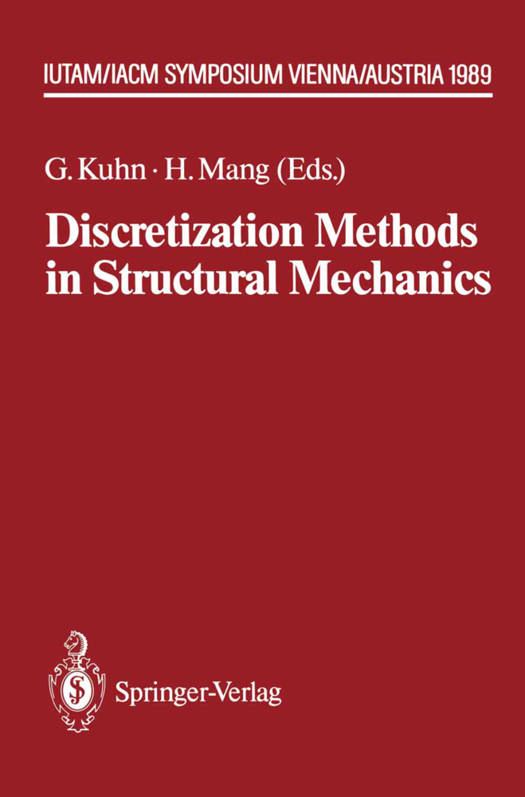
Discretization Methods in Structural Mechanics
Iutam/Iacm Symposium Vienna/Austria, 5.-9.6.1989
€ 106,95
+ 213 punten
Omschrijving
The advent of the digital computer has given great impetus to the development of modern discretization methods in structural mechanics. The young history of the finite element method (FEM) reflects the dramatic increase of computing speed and storage capacity within a relatively short period of time. The history of the boundary element method (BEM) is still younger. Presently, intense scientific efforts aimed at extending the range of application of the BEM can be observed. More than 10 years ago, O.C. Zienkiewicz and his co-workers published the first papers on the coupling of FE and BE discretizations of subregions of solids for the purpose of exploiting the complementary advantages of the two discretization methods and reducing their disadvantages. The FEM has revolutionized structural analysis in industry as well as academia. The BEM has a fair share in the continuation of this revolution. Both discretization methods have become a domain of vigorous, world-wide research activities. The rapid increase of the number of specialized journals and scientific meetings indicates the remarkable increase of research efforts in this important subdolll.ain of computational ulechanics. Several discussions of this situation in the Committee for Discretization Methods ill Solid Mechanics of the Society for Applied Mathematics and Mechanics (GAMM) resulted in the plan to submit a proposal to the General Assembly of the International Union of Theoretical and Applied Mechanics (IUTAM) to sponsor a pertinent IUTAM Symposium.
Specificaties
Betrokkenen
- Uitgeverij:
Inhoud
- Aantal bladzijden:
- 436
- Taal:
- Engels
- Reeks:
Eigenschappen
- Productcode (EAN):
- 9783642493751
- Verschijningsdatum:
- 5/06/2012
- Uitvoering:
- Paperback
- Formaat:
- Trade paperback (VS)
- Afmetingen:
- 156 mm x 234 mm
- Gewicht:
- 648 g

Alleen bij Standaard Boekhandel
+ 213 punten op je klantenkaart van Standaard Boekhandel
AANGERADEN


Beoordelingen
We publiceren alleen reviews die voldoen aan de voorwaarden voor reviews. Bekijk onze voorwaarden voor reviews.