


- Afhalen na 1 uur in een winkel met voorraad
- Gratis thuislevering in België vanaf € 30
- Ruim aanbod met 7 miljoen producten
- Afhalen na 1 uur in een winkel met voorraad
- Gratis thuislevering in België vanaf € 30
- Ruim aanbod met 7 miljoen producten





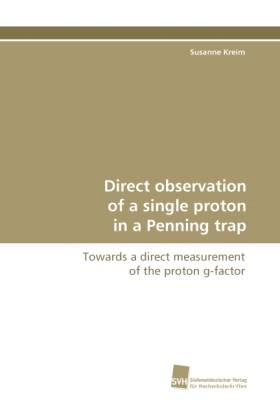
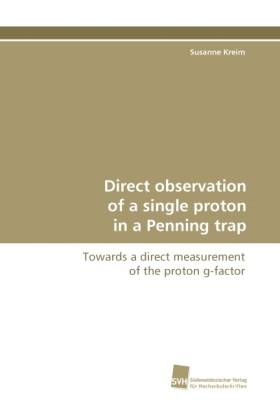
Direct observation of a single proton in a Penning trap
Towards a direct measurement of the proton g-factor
Susanne Kreim
Paperback | Engels
€ 68,95
+ 137 punten
Omschrijving
Experiments are performed on a single proton stored in a Penning trap aiming at the determination of the g-factor. The eigenmotion of an isolated, free proton could be detected electronically via coupling to a resonance circuit, which represents a non-destructive measurement. The free cyclotron frequency emerging from the measured eigenfre-quencies is one of two frequencies required for a direct determination of the magnetic moment. Design, developing, and commissioning of the experimental setup have been accomplished leading to a measuring accuracy of 10-7. The technical challenges for the determination of the second (Larmor) frequency arising from the smallness of the magnetic moment were mastered. Since the spin state required for this measurement is an internal degree of freedom, it can only be accessed through a coupling of the magnetic moment to the eigenmotion. A novel, hybrid Penning trap is presented, which im-prints the spin information onto the eigenmotion, thus, realizing a quantum jump spectrometer. Therewith, the frequency shift of the two spin states resulting from the magnetic coupling reaches for the first time an electronically detectable range.
Specificaties
Betrokkenen
- Auteur(s):
- Uitgeverij:
Inhoud
- Aantal bladzijden:
- 124
- Taal:
- Engels
Eigenschappen
- Productcode (EAN):
- 9783838111094
- Uitvoering:
- Paperback
- Afmetingen:
- 220


Alleen bij Standaard Boekhandel
+ 137 punten op je klantenkaart van Standaard Boekhandel
AANGERADEN


Beoordelingen
We publiceren alleen reviews die voldoen aan de voorwaarden voor reviews. Bekijk onze voorwaarden voor reviews.