



Bedankt voor het vertrouwen het afgelopen jaar! Om jou te bedanken bieden we GRATIS verzending (in België) aan op alles gedurende de hele maand januari.
- Afhalen na 1 uur in een winkel met voorraad
- In januari gratis thuislevering in België
- Ruim aanbod met 7 miljoen producten
Bedankt voor het vertrouwen het afgelopen jaar! Om jou te bedanken bieden we GRATIS verzending (in België) aan op alles gedurende de hele maand januari.
- Afhalen na 1 uur in een winkel met voorraad
- In januari gratis thuislevering in België
- Ruim aanbod met 7 miljoen producten





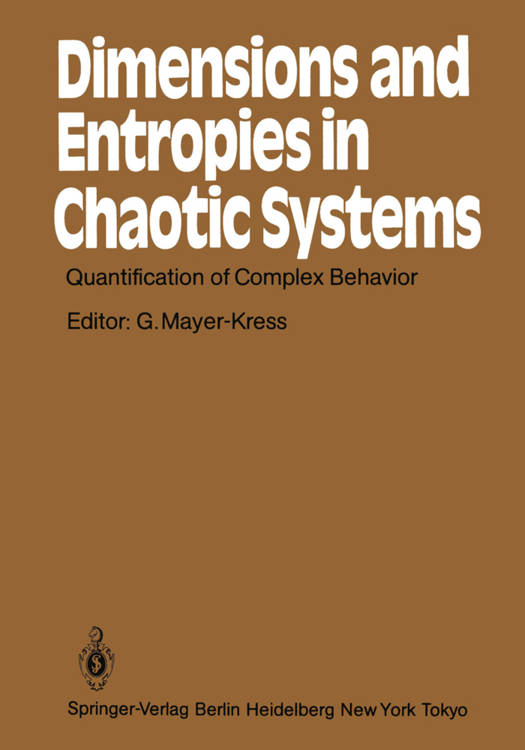
Dimensions and Entropies in Chaotic Systems
Quantification of Complex Behavior Proceeding of an International Workshop at the Pecos River Ranch, New Mexico, September 11-16, 1985
€ 83,95
+ 167 punten
Omschrijving
These proceedings contain the papers contributed to the International Work- shop on "Dimensions and Entropies in Chaotic Systems" at the Pecos River Conference Center on the Pecos River Ranch in Spetember 1985. The work- shop was held by the Center for Nonlinear Studies of the Los Alamos National Laboratory. At the Center for Nonlinear Studies the investigation of chaotic dynamics and especially the quantification of complex behavior has a long tradition. In spite of some remarkable successes, there are fundamental, as well as nu- merical, problems involved in the practical realization of these algorithms. This has led to a series of publications in which modifications and improve- ments of the original methods have been proposed. At present there exists a growing number of competing dimension algorithms but no comprehensive review explaining how they are related. Further, in actual experimental ap- plications, rather than a precise algorithm, one finds frequent use of "rules of thumb" together with error estimates which, in many cases, appear to be far too optimistic. Also it seems that questions like "What is the maximal dimension of an attractor that one can measure with a given number of data points and a given experimental resolution?" have still not been answered in a satisfactory manner for general cases.
Specificaties
Betrokkenen
- Uitgeverij:
Inhoud
- Aantal bladzijden:
- 257
- Taal:
- Engels
- Reeks:
- Reeksnummer:
- nr. 32
Eigenschappen
- Productcode (EAN):
- 9783642710032
- Verschijningsdatum:
- 24/11/2011
- Uitvoering:
- Paperback
- Formaat:
- Trade paperback (VS)
- Afmetingen:
- 170 mm x 244 mm
- Gewicht:
- 435 g

Alleen bij Standaard Boekhandel
+ 167 punten op je klantenkaart van Standaard Boekhandel
SOLDEN


Beoordelingen
We publiceren alleen reviews die voldoen aan de voorwaarden voor reviews. Bekijk onze voorwaarden voor reviews.