


- Afhalen na 1 uur in een winkel met voorraad
- Gratis thuislevering in België vanaf € 30
- Ruim aanbod met 7 miljoen producten
- Afhalen na 1 uur in een winkel met voorraad
- Gratis thuislevering in België vanaf € 30
- Ruim aanbod met 7 miljoen producten





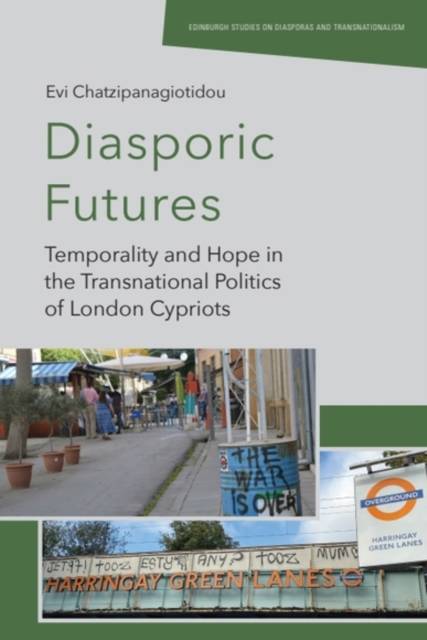
Diasporic Futures
Temporality and Hope in the Transnational Politics of London Cypriots
Evi Chatzipanagiotidou
€ 193,45
+ 386 punten
Omschrijving
Connected to a divided island, British Cypriots have participated in the reproduction of conflict and partition but have also been active agents of peacebuilding and reconciliation. Focusing on the latter, Diasporic Futures traces the transnational politics of Greek Cypriots in London during a significant historical period in which space opened for diasporic involvement in peace politics at 'home'. It applies a temporal framework and proposes that diasporas and transnationalism - often analysed through an emphasis on space - must also be understood through an investigation of time. The book argues that diasporas do not exist linearly, but are made, reorganised or enervated in and by time, aggregating at particular historical points and dissipating at others. Moreover, Diasporic Futures illustrates that, although imagined as anchored in the past and 'out of sync', diasporas are 'horizonal', made by their orientations towards the future and a politics of hope.
Specificaties
Betrokkenen
- Auteur(s):
- Uitgeverij:
Inhoud
- Aantal bladzijden:
- 304
- Taal:
- Engels
- Reeks:
Eigenschappen
- Productcode (EAN):
- 9781399502610
- Verschijningsdatum:
- 30/09/2025
- Uitvoering:
- Hardcover
- Formaat:
- Genaaid
- Afmetingen:
- 156 mm x 234 mm
- Gewicht:
- 603 g



Alleen bij Standaard Boekhandel
+ 386 punten op je klantenkaart van Standaard Boekhandel
AANGERADEN


Beoordelingen
We publiceren alleen reviews die voldoen aan de voorwaarden voor reviews. Bekijk onze voorwaarden voor reviews.