


- Afhalen na 1 uur in een winkel met voorraad
- Gratis thuislevering in België vanaf € 30
- Ruim aanbod met 7 miljoen producten
- Afhalen na 1 uur in een winkel met voorraad
- Gratis thuislevering in België vanaf € 30
- Ruim aanbod met 7 miljoen producten





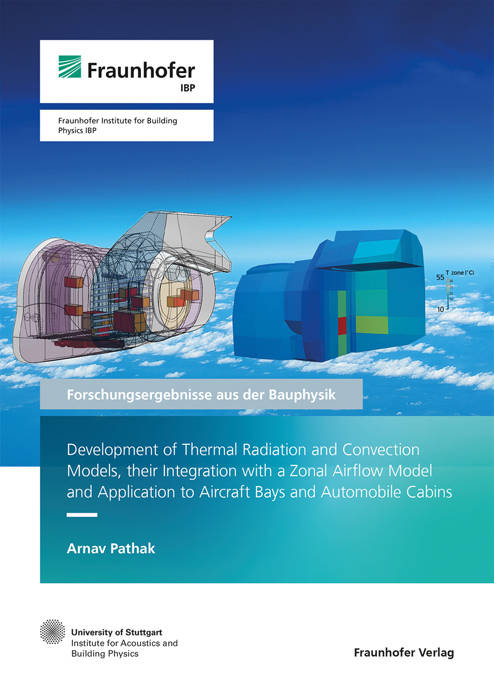
Development of Thermal Radiation and Convection Models, their Integration with a Zonal Airflow Model and Application to Aircraft Bays and Automobile Cabins
Arnav Pathak
€ 39,45
+ 78 punten
Omschrijving
The transition toward more-electric aircraft and electric vehicles introduces significant thermal management challenges due to the presence of localized heat sources and the absence of waste heat. To accurately predict the resulting thermal environment, an advanced zonal thermal modeling platform has been developed. This platform integrates high-resolution longwave radiation (RADZO), convection (CONZO), and airflow (VEPZO) models. Designed for applications in aerospace, automotive, and other complex enclosures, it offers a balance between computational efficiency and predictive accuracy. RADZO provides detailed radiative heat exchange calculations using refined surface meshes and precise view factor determination, even in obstructed and intricate geometries. CONZO employs calibrated convection models based on zonal air change per hour (ACH), enabling reliable predictions of surface heating and cooling across a wide range of configurations.
Developed models are validated across full-scale aircraft and automotive mockups. With automated geometry processing and fast simulation times, this hybrid zonal thermal modelling approach delivers good accuracy at low computational load. The zonal thermal model provides platform for engineers and thermal designers seeking a scalable, ready-to-deploy solution for complex indoor environments.
Developed models are validated across full-scale aircraft and automotive mockups. With automated geometry processing and fast simulation times, this hybrid zonal thermal modelling approach delivers good accuracy at low computational load. The zonal thermal model provides platform for engineers and thermal designers seeking a scalable, ready-to-deploy solution for complex indoor environments.
Specificaties
Betrokkenen
- Auteur(s):
- Uitgeverij:
Inhoud
- Aantal bladzijden:
- 133
- Taal:
- Engels
- Reeks:
- Reeksnummer:
- nr. 62
Eigenschappen
- Productcode (EAN):
- 9783839621325
- Uitvoering:
- Paperback
- Afmetingen:
- 148 mm x 210 mm


Alleen bij Standaard Boekhandel
+ 78 punten op je klantenkaart van Standaard Boekhandel
CADEAU


Beoordelingen
We publiceren alleen reviews die voldoen aan de voorwaarden voor reviews. Bekijk onze voorwaarden voor reviews.