


- Afhalen na 1 uur in een winkel met voorraad
- Gratis thuislevering in België vanaf € 30
- Ruim aanbod met 7 miljoen producten
- Afhalen na 1 uur in een winkel met voorraad
- Gratis thuislevering in België vanaf € 30
- Ruim aanbod met 7 miljoen producten





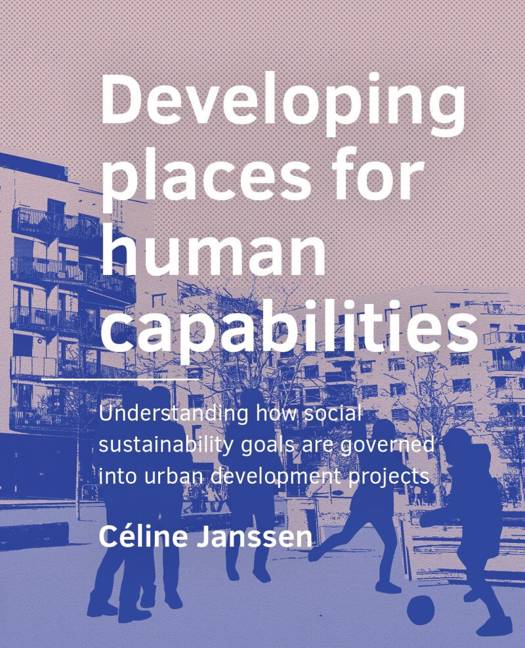
Developing places for human capabilities
Understanding how social -sustainability goals are governed into urban development projects
Céline Janssen
€ 19,95
+ 39 punten
Omschrijving
This dissertation develops an understanding towards governing social sustainability goals into area-based urban development projects. It draws on Amartya Sen’s Capability Approach to construct a capability-centered evaluation of how institutionalized governance processes around these projects ultimately affect people’s freedoms to do the things they value in their urban living environment. Presenting case studies from the Netherlands, Sweden and Austria, the approach adopted in this dissertation reveals the unique ways in which different individuals interpret urban social sustainability and convert spatial resources into personal capabilities. The research uncovers the governance elements and institutional conditions around urban development projects that enable or constrain resource-to-capability conversions. It shows that governing social sustainability goals into urban development projects is a balancing act between reflexive governance action on the one hand, and an institutionalization of principles, actor responsibilities, and funding provision on the other hand. Ultimately, this dissertation argues that, to steer towards urban social sustainability, urban development practices can be improved by adopting an approach that is not merely focused on spatial improvements, but takes the equal expansion of human capabilities as its point of departure.
Specificaties
Betrokkenen
- Auteur(s):
- Uitgeverij:
Inhoud
- Aantal bladzijden:
- 256
- Taal:
- Engels
- Reeks:
Eigenschappen
- Productcode (EAN):
- 9789463667999
- Verschijningsdatum:
- 15/01/2023
- Uitvoering:
- Paperback
- Afmetingen:
- 191 mm x 235 mm
- Gewicht:
- 600 g


Alleen bij Standaard Boekhandel
+ 39 punten op je klantenkaart van Standaard Boekhandel
Cadeau

AANGERADEN


Beoordelingen
We publiceren alleen reviews die voldoen aan de voorwaarden voor reviews. Bekijk onze voorwaarden voor reviews.