


- Afhalen na 1 uur in een winkel met voorraad
- Gratis thuislevering in België vanaf € 30
- Ruim aanbod met 7 miljoen producten
- Afhalen na 1 uur in een winkel met voorraad
- Gratis thuislevering in België vanaf € 30
- Ruim aanbod met 7 miljoen producten





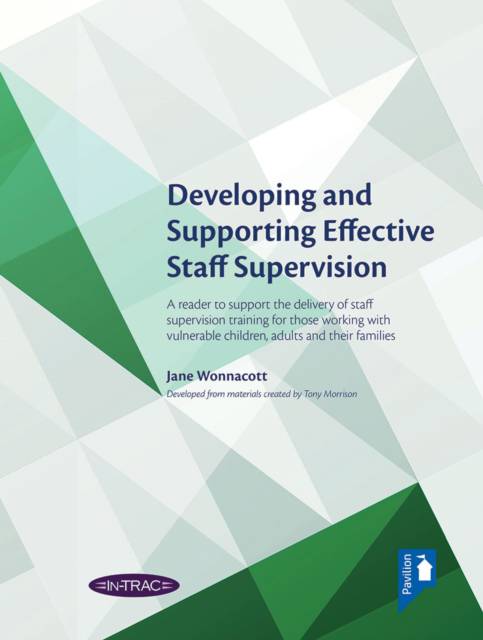
Developing and Supporting Effective Staff Supervision Reader
A Reader to Support the Delivery of Staff Supervision Training for Those Working with Vulnerable Children, Adults and Their Families
Jane Wonnacott
Paperback | Engels
€ 22,45
+ 44 punten
Omschrijving
Developing and Supporting Effective Staff Supervision draws on the core concepts in Tony Morrison's Staff Supervision in Social Care (Pavilion, 2005) and demonstrates how they can be used to train staff to deliver sound and effective supervision that makes a real difference to service users. The author of this pack, Jane Wonnacott, was a close colleague of Tony Morrison and worked with him at In-Trac Training and Consultancy Ltd. This reader accompanies the training pack of the same name and is for use by experienced trainers who are well grounded in supervision practice and theory. The reader gives further detail on supervision theory and provides a good source of preparatory material. While the reader aims to draw out the main building blocks of the supervision model outlined in Staff Supervision in Social Care (Pavilion, 2005), as well as the more recent developments of this the approach, it is not meant to be a 'dumbing down' or an over-simplification of the issues. The underpinning belief throughout the reader is that working with human relationships is complex and demanding and cannot be packaged neatly into a one-size-fits-all prescribed way of responding. The supervision model and accompanying tools have always been designed to enable practitioners to respond to the individual nature of the issues they are working with and create the a reflective space for exploring challenging issues and ideas, using the knowledge generated through the process to inform both front line practice and the strategic direction of the organisation. The joy of Morrison's approach has always been the way in which it takes complex ideas, makes them accessible to a wide audience and alongside this gives people tools to help them in their day-to-day practice. This publication aims to continue this approach by reminding readers of core aspects of the model which, if implemented, will provide the foundations for an approach to supervision that makes a real difference to those using social care and health services. Professionals within the social care sector are required to undertake Continuous Professional Development (CPD) by the Health and Care Professions Council (HCPC). Those who use this resource will be able to gain CPD points.
Specificaties
Betrokkenen
- Auteur(s):
- Uitgeverij:
Inhoud
- Aantal bladzijden:
- 130
- Taal:
- Engels
Eigenschappen
- Productcode (EAN):
- 9781908993557
- Verschijningsdatum:
- 1/01/2014
- Uitvoering:
- Paperback
- Formaat:
- Trade paperback (VS)
- Afmetingen:
- 178 mm x 241 mm
- Gewicht:
- 362 g


Alleen bij Standaard Boekhandel
+ 44 punten op je klantenkaart van Standaard Boekhandel

Beoordelingen
We publiceren alleen reviews die voldoen aan de voorwaarden voor reviews. Bekijk onze voorwaarden voor reviews.