


- Afhalen na 1 uur in een winkel met voorraad
- Gratis thuislevering in België vanaf € 30
- Ruim aanbod met 7 miljoen producten
- Afhalen na 1 uur in een winkel met voorraad
- Gratis thuislevering in België vanaf € 30
- Ruim aanbod met 7 miljoen producten





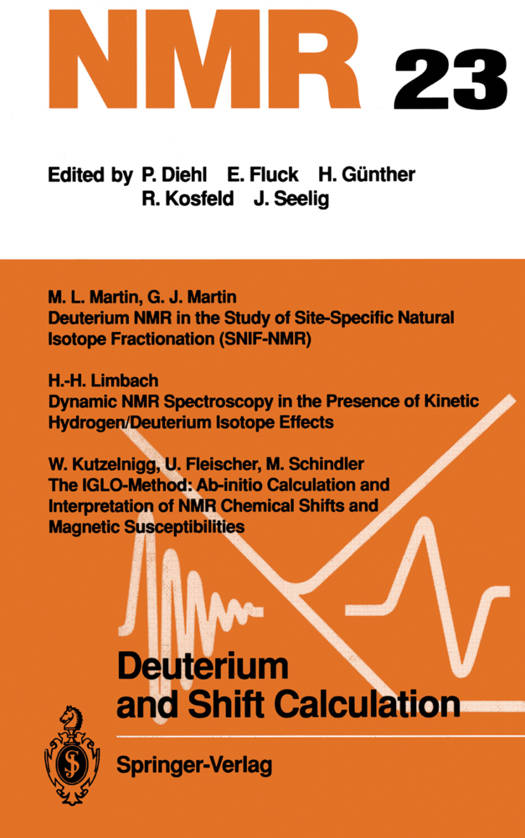
Deuterium and Shift Calculation
€ 150,48
+ 300 punten
Omschrijving
In 1931 Vrey, Brickwedde, and Murphy discovered the hydrogen isotope deuterium. The isotopic enrichment was found to arise from the fact that the electrolysis oflight water is faster than of heavy water [1,2]. This success showed that although different isotopes of an element behave identically from a chemical standpoint the different isotopic masses nevertheless lead to both isotope effects on equilibrium as well as on rate constants of chemical reactions. Soon, ratios of equilibrium constants of isotopic reactions were called "equilibrium isotope effects" (EIE), ratios of isotopic rate constants "kinetic isotope effects" (KIE). Isotope effects have been found to be especially large for those elements which are directly involved in bond breaking and bond formation during the reaction studied [3]. Such effects are, therefore, referred to as "primary". Isotopic substitution in atomic sites which maintain all chemical bonds with their neighbors during the reaction of interest leads then only to smaller "secondary" isotope effects. Because of the unique mass relation between the different hydrogen isotopes hydrogen/deuterium isotope effects are particularly large and have attracted most attention. The largest contributions to these effects arise from changes in the vibrational frequencies of the reactants. The theory of equilibrium isotope effects has been founded by Vrey [4] and Bigeleisen [5,6] and has widely been accepted [3].
Specificaties
Betrokkenen
- Uitgeverij:
Inhoud
- Aantal bladzijden:
- 263
- Taal:
- Engels
- Reeks:
- Reeksnummer:
- nr. 23
Eigenschappen
- Productcode (EAN):
- 9783642759345
- Verschijningsdatum:
- 24/02/2012
- Uitvoering:
- Paperback
- Formaat:
- Trade paperback (VS)
- Afmetingen:
- 156 mm x 234 mm
- Gewicht:
- 390 g

Alleen bij Standaard Boekhandel
+ 300 punten op je klantenkaart van Standaard Boekhandel
Wedstrijd


Beoordelingen
We publiceren alleen reviews die voldoen aan de voorwaarden voor reviews. Bekijk onze voorwaarden voor reviews.