



Bedankt voor het vertrouwen het afgelopen jaar! Om jou te bedanken bieden we GRATIS verzending (in België) aan op alles gedurende de hele maand januari.
- Afhalen na 1 uur in een winkel met voorraad
- In januari gratis thuislevering in België
- Ruim aanbod met 7 miljoen producten
Bedankt voor het vertrouwen het afgelopen jaar! Om jou te bedanken bieden we GRATIS verzending (in België) aan op alles gedurende de hele maand januari.
- Afhalen na 1 uur in een winkel met voorraad
- In januari gratis thuislevering in België
- Ruim aanbod met 7 miljoen producten





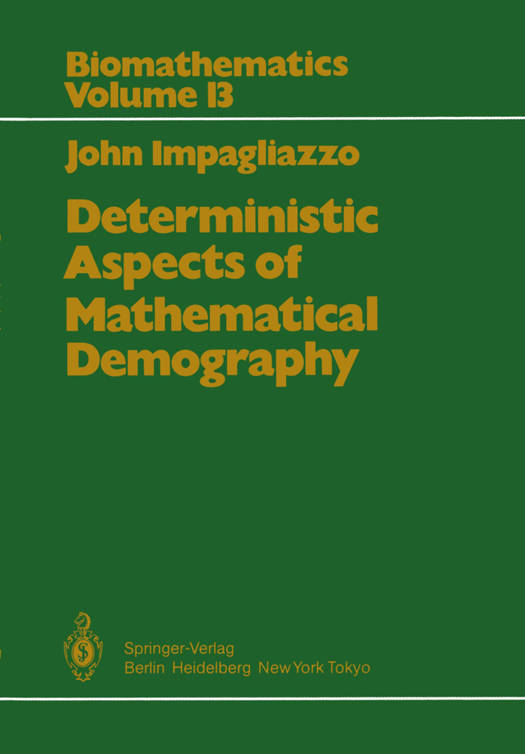
Deterministic Aspects of Mathematical Demography
An Investigation of the Stable Theory of Population Including an Analysis of the Population Statistics of Denmark
J Impagliazzo
€ 83,95
+ 167 punten
Omschrijving
Mathematical Demography, the study of population and its analysis through mathematical models, has received increased interest in the mathematical com- munity in recent years. It was not until the twentieth century, however, that the study of population, predominantly human population, achieved its math- ematical character. The subject of mathematical demography can be viewed from either a deterministic viewpoint or from a stochastic viewpoint. For the sake of brevity, stochastic models are not included in this work. It is, therefore, my intention to consider only established deterministic models in this discussion, starting with the life table as the earliest model, to a generalized matrix model which is developed in this treatise. These deterministic models provide sufficient de- velopment and conclusions to formulate sound mathematical population analy- sis and estimates of population projections. It should be noted that although the subject of mathematical demography focuses on human populations, the development and results may be applied to any population as long as the preconditions that make the model valid are maintained. Information concerning mathematical demography is at best fragmented.
Specificaties
Betrokkenen
- Auteur(s):
- Uitgeverij:
Inhoud
- Aantal bladzijden:
- 188
- Taal:
- Engels
- Reeks:
- Reeksnummer:
- nr. 13
Eigenschappen
- Productcode (EAN):
- 9783642823213
- Verschijningsdatum:
- 10/01/2012
- Uitvoering:
- Paperback
- Formaat:
- Trade paperback (VS)
- Afmetingen:
- 170 mm x 244 mm
- Gewicht:
- 331 g


Alleen bij Standaard Boekhandel
+ 167 punten op je klantenkaart van Standaard Boekhandel
SOLDEN


Beoordelingen
We publiceren alleen reviews die voldoen aan de voorwaarden voor reviews. Bekijk onze voorwaarden voor reviews.