


- Afhalen na 1 uur in een winkel met voorraad
- Gratis thuislevering in België vanaf € 30
- Ruim aanbod met 7 miljoen producten
- Afhalen na 1 uur in een winkel met voorraad
- Gratis thuislevering in België vanaf € 30
- Ruim aanbod met 7 miljoen producten





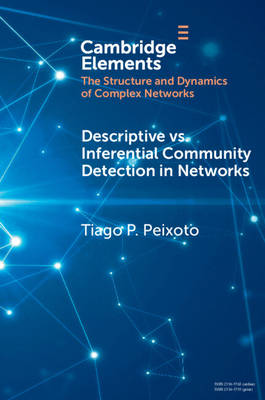
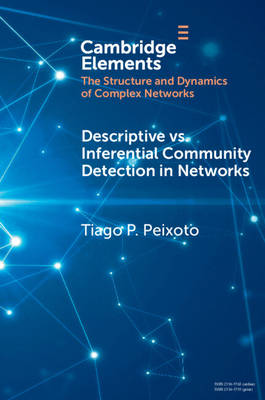
Descriptive vs. Inferential Community Detection in Networks
Pitfalls, Myths and Half-Truths
Tiago P Peixoto
€ 36,45
+ 72 punten
Omschrijving
Community detection is one of the most important methodological fields of network science, and one which has attracted a significant amount of attention over the past decades. This area deals with the automated division of a network into fundamental building blocks, with the objective of providing a summary of its large-scale structure. Despite its importance and widespread adoption, there is a noticeable gap between what is arguably the state-of-the-art and the methods which are actually used in practice in a variety of fields. The Elements attempts to address this discrepancy by dividing existing methods according to whether they have a 'descriptive' or an 'inferential' goal. While descriptive methods find patterns in networks based on context-dependent notions of community structure, inferential methods articulate a precise generative model, and attempt to fit it to data. In this way, they are able to provide insights into formation mechanisms and separate structure from noise. This title is also available as open access on Cambridge Core.
Specificaties
Betrokkenen
- Auteur(s):
- Uitgeverij:
Inhoud
- Aantal bladzijden:
- 84
- Taal:
- Engels
- Reeks:
Eigenschappen
- Productcode (EAN):
- 9781009113007
- Verschijningsdatum:
- 31/08/2023
- Uitvoering:
- Paperback
- Formaat:
- Trade paperback (VS)
- Afmetingen:
- 152 mm x 229 mm
- Gewicht:
- 122 g


Alleen bij Standaard Boekhandel
+ 72 punten op je klantenkaart van Standaard Boekhandel
Cadeau

AANGERADEN


Beoordelingen
We publiceren alleen reviews die voldoen aan de voorwaarden voor reviews. Bekijk onze voorwaarden voor reviews.