


- Afhalen na 1 uur in een winkel met voorraad
- Gratis thuislevering in België vanaf € 30
- Ruim aanbod met 7 miljoen producten
- Afhalen na 1 uur in een winkel met voorraad
- Gratis thuislevering in België vanaf € 30
- Ruim aanbod met 7 miljoen producten




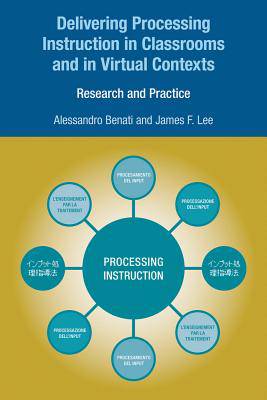
Delivering Processing Instruction in Classrooms and in Virtual Contexts
Research and Practice
Alessandro G Benati, James F Lee
Paperback | Engels
€ 42,95
+ 85 punten
Omschrijving
Processing Instruction (PI) is an approach to grammar instruction for second language learning. It derives its name from the fact that the instruction (both the explicit explanation as well as the practices) attempt to influence, alter, and/or improve the way learners process input. PI contrasts with traditional grammar instruction in many ways, principally in its focus on the learner's input rather than their output. This book focuses on a new issue for PI, the role of technology in language learning. The authors compare empirically the differential effects of delivering PI in classrooms with an instructor and students interacting (with each other and with the instructor) with students working individually on computers. This book makes a valuable contribution to the growing body of research on the effects of PI on different languages, as well as different linguistic items: preterite/imperfect aspectual contrast and negative informal commands in Spanish, the subjunctive of doubt and opinion in Italian, and the subjunctive of doubt in French.
Specificaties
Betrokkenen
- Auteur(s):
- Uitgeverij:
Inhoud
- Aantal bladzijden:
- 224
- Taal:
- Engels
Eigenschappen
- Productcode (EAN):
- 9781845532482
- Verschijningsdatum:
- 31/12/2007
- Uitvoering:
- Paperback
- Formaat:
- Trade paperback (VS)
- Afmetingen:
- 232 mm x 158 mm
- Gewicht:
- 254 g


Alleen bij Standaard Boekhandel
+ 85 punten op je klantenkaart van Standaard Boekhandel
AANGERADEN


Beoordelingen
We publiceren alleen reviews die voldoen aan de voorwaarden voor reviews. Bekijk onze voorwaarden voor reviews.