


- Afhalen na 1 uur in een winkel met voorraad
- Gratis thuislevering in België vanaf € 30
- Ruim aanbod met 7 miljoen producten
- Afhalen na 1 uur in een winkel met voorraad
- Gratis thuislevering in België vanaf € 30
- Ruim aanbod met 7 miljoen producten





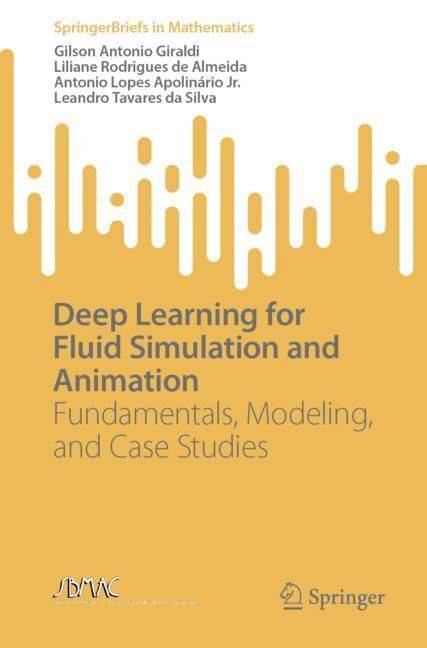
Deep Learning for Fluid Simulation and Animation
Fundamentals, Modeling, and Case Studies
Gilson Antonio Giraldi, Liliane Rodrigues de Almeida, Antonio Lopes Apolinário Jr., Leandro Tavares da Silva
€ 48,45
+ 96 punten
Omschrijving
This book is an introduction to the use of machine learning and data-driven approaches in fluid simulation and animation, as an alternative to traditional modeling techniques based on partial differential equations and numerical methods - and at a lower computational cost.
This work starts with a brief review of computability theory, aimed to convince the reader - more specifically, researchers of more traditional areas of mathematical modeling - about the power of neural computing in fluid animations. In these initial chapters, fluid modeling through Navier-Stokes equations and numerical methods are also discussed.
The following chapters explore the advantages of the neural networks approach and show the building blocks of neural networks for fluid simulation. They cover aspects related to training data, data augmentation, and testing.
The volume completes with two case studies, one involving Lagrangian simulation of fluids using convolutional neural networks and the other using Generative Adversarial Networks (GANs) approaches.
This work starts with a brief review of computability theory, aimed to convince the reader - more specifically, researchers of more traditional areas of mathematical modeling - about the power of neural computing in fluid animations. In these initial chapters, fluid modeling through Navier-Stokes equations and numerical methods are also discussed.
The following chapters explore the advantages of the neural networks approach and show the building blocks of neural networks for fluid simulation. They cover aspects related to training data, data augmentation, and testing.
The volume completes with two case studies, one involving Lagrangian simulation of fluids using convolutional neural networks and the other using Generative Adversarial Networks (GANs) approaches.
Specificaties
Betrokkenen
- Auteur(s):
- Uitgeverij:
Inhoud
- Aantal bladzijden:
- 164
- Taal:
- Engels
- Reeks:
Eigenschappen
- Productcode (EAN):
- 9783031423321
- Verschijningsdatum:
- 25/11/2023
- Uitvoering:
- Paperback
- Afmetingen:
- 155 mm x 9 mm


Alleen bij Standaard Boekhandel
+ 96 punten op je klantenkaart van Standaard Boekhandel
Cadeau

AANGERADEN


Beoordelingen
We publiceren alleen reviews die voldoen aan de voorwaarden voor reviews. Bekijk onze voorwaarden voor reviews.