


- Afhalen na 1 uur in een winkel met voorraad
- Gratis thuislevering in België vanaf € 30
- Ruim aanbod met 7 miljoen producten
- Afhalen na 1 uur in een winkel met voorraad
- Gratis thuislevering in België vanaf € 30
- Ruim aanbod met 7 miljoen producten





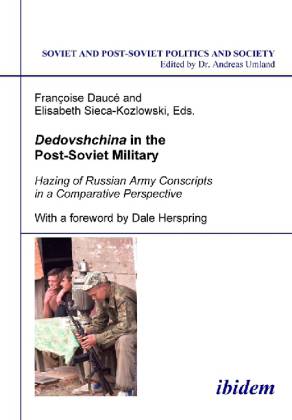
Dedovshchina in the Post-Soviet Military. Hazing of Russian Army Conscripts in a Comparative Perspective. With a foreword by Dale Herspring
Hazing of Russian Army Conscripts in a Comparative Perspective
Francoise Dauce, Elisabeth Sieca-Kozlowski
Paperback | Engels
€ 31,95
+ 63 punten
Omschrijving
In contemporary armies, violence among soldiers seems to be a universal phenomenon found in both professional and drafted armies. However, the comparison of violent practices in various armies around the world allows us to identify specific features linked to those countries' sociological, political or anthropological contexts. Hazing, for example, seems to be more violent in the armies of transitional societies (Russia, Eastern Europe, Latin America), where social tensions encountered by citizens in their daily lives are carried over to, and sometimes intensified in, the military. The comparison of Russian dedovshchina with the situation in other countries makes it possible to identify universal, transitional and national characteristics of military violence.Contents: Konstantin Bannikov on the consequences of the spread throughout society of archaic violence produced by the Russian army; Anna Colin Lebedev on the perception of military violence in Russian society; Anton Oleynik on informal relationships among prisoners and conscripts; Kirill Podrabinek on the reasons of the prevalence of dedovshchina in the post-Soviet context; Igor Obraztsov on the historical roots of dedovshchina; Vadim Mikhailin on the role of language in the military milieu; Julie Elkner on the Committee of Soldiers' Mothers; Bakit Katchekeyev on hazing in the Kyrgyz army; Irakli Sesiashvili on hazing in the Georgian army; Hana Cervinkova on hazing in the Czech army; James Wither on bullying in the British army; Eduardo Paes-Machado & Carlos Linhares de Albuquerque on hazing in the Brazilian police; Joris Van Bladel on dedovshchina and the all-volunteer force.
Specificaties
Betrokkenen
- Auteur(s):
- Uitgeverij:
Inhoud
- Aantal bladzijden:
- 310
- Taal:
- Engels
Eigenschappen
- Productcode (EAN):
- 9783898216166
- Verschijningsdatum:
- 8/03/2006
- Uitvoering:
- Paperback
- Formaat:
- Trade paperback (VS)
- Afmetingen:
- 148 mm x 210 mm
- Gewicht:
- 371 g


Alleen bij Standaard Boekhandel
+ 63 punten op je klantenkaart van Standaard Boekhandel
Cadeau

AANGERADEN


Beoordelingen
We publiceren alleen reviews die voldoen aan de voorwaarden voor reviews. Bekijk onze voorwaarden voor reviews.