



Bedankt voor het vertrouwen het afgelopen jaar! Om jou te bedanken bieden we GRATIS verzending (in België) aan op alles gedurende de hele maand januari.
- Afhalen na 1 uur in een winkel met voorraad
- In januari gratis thuislevering in België
- Ruim aanbod met 7 miljoen producten
Bedankt voor het vertrouwen het afgelopen jaar! Om jou te bedanken bieden we GRATIS verzending (in België) aan op alles gedurende de hele maand januari.
- Afhalen na 1 uur in een winkel met voorraad
- In januari gratis thuislevering in België
- Ruim aanbod met 7 miljoen producten





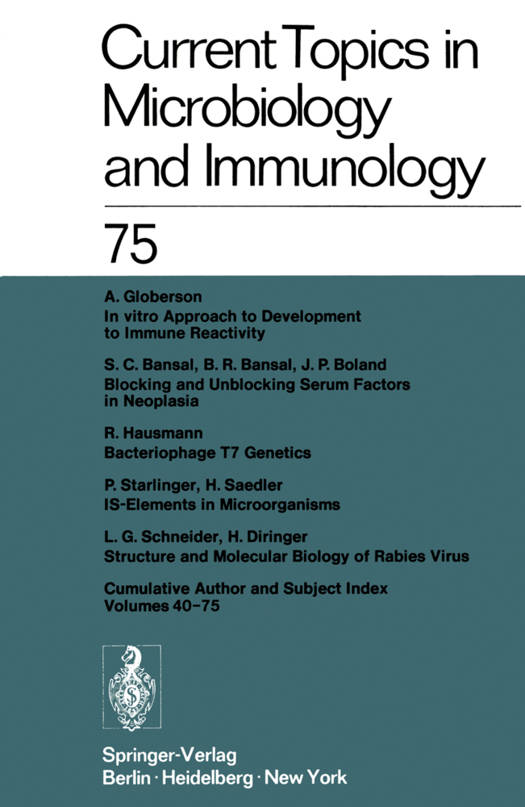
Current Topics in Microbiology and Immunology / Ergebnisse Der Microbiologie Und Immunitätsforschung
W Arber, W Henle, P H Hofschneider, J H Humphrey, N K Jerne, P Koldovský, H Koprowski, O Maaløe, R Rott, H G Schweiger, M Sela, L Syru?ek, P K Vogt
€ 139,95
+ 279 punten
Uitvoering
Omschrijving
Expression of an immune response is the net result of complex synergis- tic and antagonistic activities performed by a variety of cell types. It includes macrophages, T and B populations which may interact in performance of a response, and suppressor cells interfering with it. Accordingly, a lack of res- ponse may not necessarily indicate absence of immunocompetent cells, but rather nonexpression of competence. Thus, one should consider two possible situations, which are by no means mutually exclusive, to account for immuno- logic unresponsiveness: (a) one or more of the cell populations composing the synergistic unit is absent or immature, and (b) an antagonistic unit which interferes with the response is dominating. In view of this, an approach to development of immune reactivity necessitates parallel surveys of development of cells with the potential to perform, as well as of cells which can suppress the response. Classification of the various cell types has been based so far on their phenotypic properties (e. g., membrane antigen markers, cell receptors, pro- duction and secretion of immunoglobulins, etc. ). Genotypically, T and B cells may represent either separate, independent cell lines, or different stages of development within the same cell lineage.
Specificaties
Betrokkenen
- Auteur(s):
- Uitgeverij:
Inhoud
- Aantal bladzijden:
- 202
- Taal:
- Engels
- Reeks:
- Reeksnummer:
- nr. 75
Eigenschappen
- Productcode (EAN):
- 9783642665325
- Verschijningsdatum:
- 23/11/2011
- Uitvoering:
- Paperback
- Formaat:
- Trade paperback (VS)
- Afmetingen:
- 170 mm x 244 mm
- Gewicht:
- 340 g


Alleen bij Standaard Boekhandel
+ 279 punten op je klantenkaart van Standaard Boekhandel
SOLDEN


Beoordelingen
We publiceren alleen reviews die voldoen aan de voorwaarden voor reviews. Bekijk onze voorwaarden voor reviews.