



Bedankt voor het vertrouwen het afgelopen jaar! Om jou te bedanken bieden we GRATIS verzending (in België) aan op alles gedurende de hele maand januari.
- Afhalen na 1 uur in een winkel met voorraad
- In januari gratis thuislevering in België
- Ruim aanbod met 7 miljoen producten
Bedankt voor het vertrouwen het afgelopen jaar! Om jou te bedanken bieden we GRATIS verzending (in België) aan op alles gedurende de hele maand januari.
- Afhalen na 1 uur in een winkel met voorraad
- In januari gratis thuislevering in België
- Ruim aanbod met 7 miljoen producten





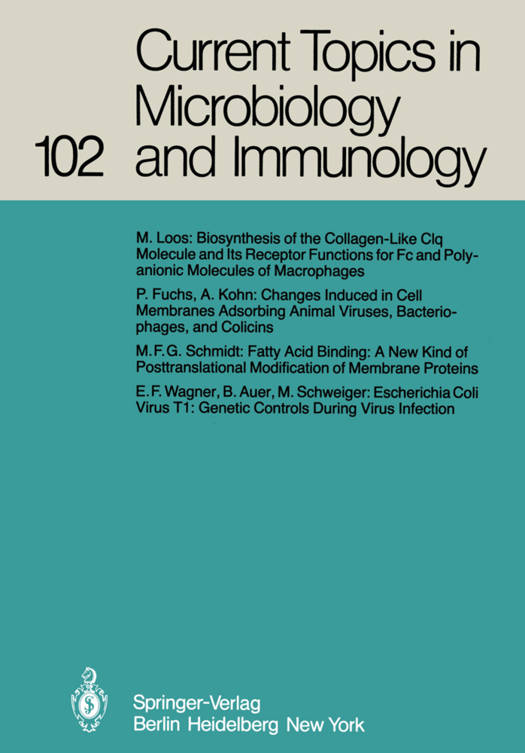
Current Topics in Microbiology and Immunology
Volume 102
M Cooper, P H Hofschneider, H Koprowski, F Melchers, R Rott, H G Schweiger, P K Vogt, R Zinkernagel
€ 139,95
+ 279 punten
Omschrijving
Binding of various ligands (hormones, neurotransmitters, immunological stimuli) to membrane receptors induces the following changes: 1. Receptor redistribution (clustering, "capping") 2. Conformational changes that can be detected by fluorescent probes 3. Alteration in membrane fluidity (spin label and fluorescence polarization probes) 4. Changes in fluxes of ions and metabolites 5. Increased phospholipid turnover (especially of phosphatidyl inositol) 6. Activation of membrane-bound enzymes (adenyl cyclase, ATPase, transmethylases). Some of the early changes resulting from or associated with the binding (adsorption) of virions to the host cell membrane are of the same type. Adsorption of animal viruses to cells is the ftrst step in a chain of events resulting in the production of progeny virus on the one hand and in damage to cells and tissues on the other. In the classical studies of viral infection, cells are adsorbed with virus, usually for 60 min, and the changes induced by the virus in the host cell are recorded thereafter. In the past decade, more and more studies have been aimed at the events occurring in these ftrst 60 min of the so-called adsorption period. These studies deal with the nature of adsorption, e. g., the ligand-receptor type of interaction between the virus and the cell membrane. Many receptors for viruses were identifted and so were the viral proteins which take part in adsorption.
Specificaties
Betrokkenen
- Auteur(s):
- Uitgeverij:
Inhoud
- Aantal bladzijden:
- 154
- Taal:
- Engels
- Reeks:
- Reeksnummer:
- nr. 102
Eigenschappen
- Productcode (EAN):
- 9783642689086
- Verschijningsdatum:
- 7/12/2011
- Uitvoering:
- Paperback
- Formaat:
- Trade paperback (VS)
- Afmetingen:
- 170 mm x 244 mm
- Gewicht:
- 263 g


Alleen bij Standaard Boekhandel
+ 279 punten op je klantenkaart van Standaard Boekhandel
SOLDEN


Beoordelingen
We publiceren alleen reviews die voldoen aan de voorwaarden voor reviews. Bekijk onze voorwaarden voor reviews.