


- Afhalen na 1 uur in een winkel met voorraad
- Gratis thuislevering in België vanaf € 30
- Ruim aanbod met 7 miljoen producten
- Afhalen na 1 uur in een winkel met voorraad
- Gratis thuislevering in België vanaf € 30
- Ruim aanbod met 7 miljoen producten





€ 36,45
+ 72 punten
Omschrijving
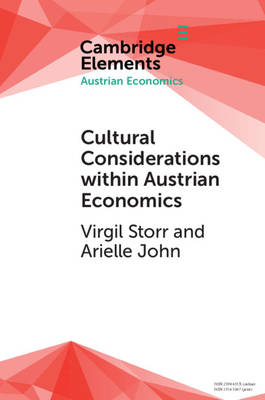
Increasingly, economists realize that a deeper understanding of culture can improve their insights into the most important questions in economics. The Austrian school of political economy, which has always taken economics to be a science of meaning, and therefore, a science of culture, offers a unique approach to the study of culture in economic life. We consider three important differences between these Austrian and non-Austrian approaches: the Austrian focus on culture as meaning rather than culture as norms, beliefs, or attitudes; the Austrian emphasis on culture as an interpretative lens rather than as a tool or form of capital; and the Austrian insistence that cultural analysis be a qualitative exercise rather than a quantitative one. We also examine Geertz's description of culture, Gadamer's approach to hermeneutics, and Weber's interpretative sociology, demonstrating their connections to the Austrian approach and offering examples of what Austrian cultural economics can look like.
Specificaties
Betrokkenen
- Auteur(s):
- Uitgeverij:
Inhoud
- Aantal bladzijden:
- 68
- Taal:
- Engels
- Reeks:
Eigenschappen
- Productcode (EAN):
- 9781108708166
- Verschijningsdatum:
- 09/07/2020
- Uitvoering:
- Paperback
- Formaat:
- Trade paperback (VS)
- Afmetingen:
- 152 mm x 229 mm
- Gewicht:
- 104 g


Alleen bij Standaard Boekhandel
+ 72 punten op je klantenkaart van Standaard Boekhandel
Cadeau

AANGERADEN


Beoordelingen
We publiceren alleen reviews die voldoen aan de voorwaarden voor reviews. Bekijk onze voorwaarden voor reviews.