


Bedankt voor het vertrouwen het afgelopen jaar! Om jou te bedanken bieden we GRATIS verzending (in België) aan op alles gedurende de hele maand januari.
- Afhalen na 1 uur in een winkel met voorraad
- In januari gratis thuislevering in België
- Ruim aanbod met 7 miljoen producten
Bedankt voor het vertrouwen het afgelopen jaar! Om jou te bedanken bieden we GRATIS verzending (in België) aan op alles gedurende de hele maand januari.
- Afhalen na 1 uur in een winkel met voorraad
- In januari gratis thuislevering in België
- Ruim aanbod met 7 miljoen producten


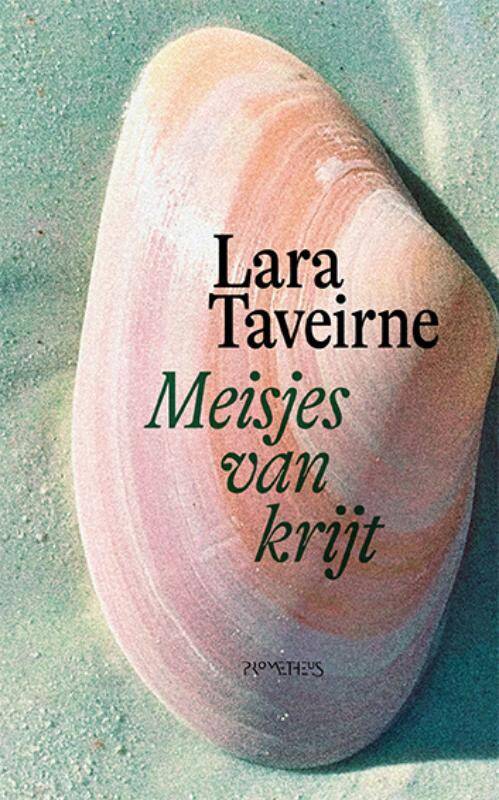


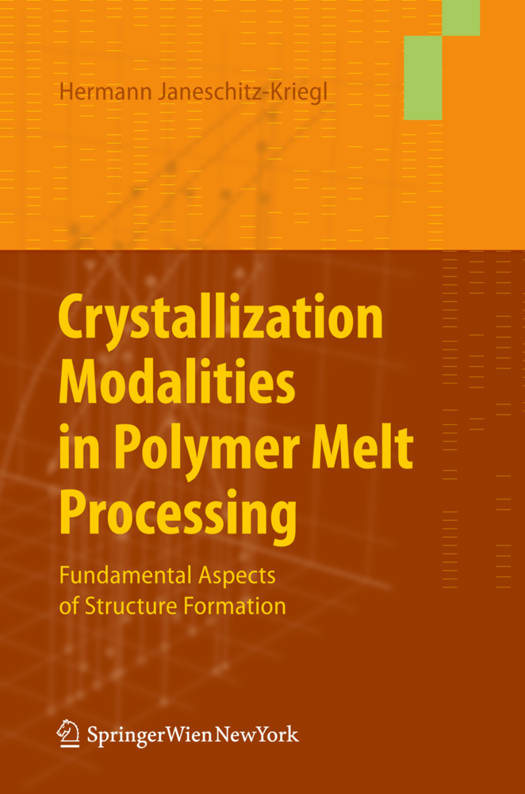
Crystallization Modalities in Polymer Melt Processing
Fundamental Aspects of Structure Formation
Hermann Janeschitz-Kriegl
Hardcover | Engels
€ 167,95
+ 335 punten
Uitvoering
Omschrijving
Structure formation in crystallizing polymers, as occurring during processing, has not been treated so far in a coherent form. This fact explains, why this monograph is written as the ?rst book devoted to this subject. A quarter of a century ago the underdevelopment of this subject was obvious. Trial and error dominated. In fact, other apposite subjects as polymer melt rheology or heat transfer, had reached high levels. A great number of books has been devoted to them. Mold ?lling of amorphous polymers and the solidi?cation of these polymers by vitri?cation can nowadays be simulated numerically with a high degree of accuracy. In the solidi?ed sample even residual stresses and corresponding birefringence effects can accurately be 1 calculated . However, semicrystalline polymers, which form the majority of industrial po- mers, have been excluded from these considerations for good reasons. In fact, great uncertainties existed about the formation of quality determining crystalline str- tures. In particular, polyole?ns suffered from this shortcoming. In 1983 this fact instigated the polymer research group at the Johannes Kepler University in Linz to start with pertinent activities. The urgency of this kind of studies becomes evident, if advantages and hitches of these polymers are considered. 1. Versatility of processing: Injection molding into a great variety of shapes and sizes, from thin walled beakers to garden chairs, not to forget pipe and pro?le extrusion, cable coating, ?ber spinning, ?lm blowing. 2. Product qualities: Ductility, low density, good electric insulation, corrosion resistance, surface quality.
Specificaties
Betrokkenen
- Auteur(s):
- Uitgeverij:
Inhoud
- Aantal bladzijden:
- 221
- Taal:
- Engels
Eigenschappen
- Productcode (EAN):
- 9783211876268
- Verschijningsdatum:
- 28/10/2009
- Uitvoering:
- Hardcover
- Formaat:
- Genaaid
- Afmetingen:
- 160 mm x 239 mm
- Gewicht:
- 521 g


Alleen bij Standaard Boekhandel
+ 335 punten op je klantenkaart van Standaard Boekhandel
SOLDEN


Beoordelingen
We publiceren alleen reviews die voldoen aan de voorwaarden voor reviews. Bekijk onze voorwaarden voor reviews.