


- Afhalen na 1 uur in een winkel met voorraad
- Gratis thuislevering in België vanaf € 30
- Ruim aanbod met 7 miljoen producten
- Afhalen na 1 uur in een winkel met voorraad
- Gratis thuislevering in België vanaf € 30
- Ruim aanbod met 7 miljoen producten





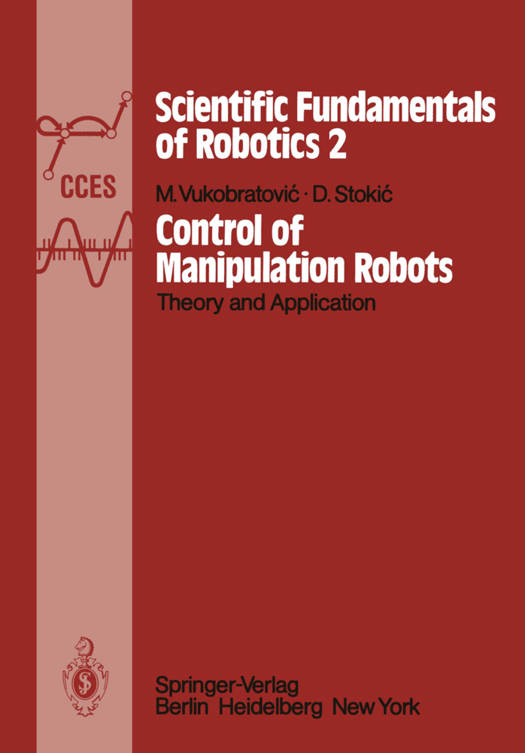
Control of Manipulation Robots
Theory and Application
M Vukobratovic, D Stokic
Paperback | Engels | Communications and Control Engineering | Scientific Fundamentals of Robotics | nr. 2
€ 100,95
+ 201 punten
Omschrijving
This monograph represents the second book of the series entitled: "SCI- ENTIFIC FUNDAl-1ENTALS OF ROBOTICS". While the first volume provides a study of the dynamics of spatial mechanisms and its application to the design of these mechanisms, the present one focuses on the synthesis -of control based n the knowledge of dynamic models (presented in de- tail in the first_ volume). In this way a logical continuity is formed in which one may easily recognize a "dynamic" approach to the design of manipulation r-obots and the synthesis of control algorithms based on exact mathematical models of dynamics of open spatial mechanisms. When writing the monograph, the authors had the following objective: to prove that a study of dynamic properties of manipulation mechanisms is justifiable, to use the dynamic properties in the synthesis of con- trol algorithms, and to determine, from one case to another, a proper measure of dynamics depending on the type of manipulation task, the "v$!locity at which "it is carried out, and on the type of the manipu- tion mechanisms itself. The authors believe they have thus made the study of dynamics, ' aimed at synthesizing algorithms for dynamic con- trol, free from unnecessary academicism and allowed the readers to apply all the results presented here to practical purposes of manipu- lator design in thfil broader sense of the word. At this point, the au- thors would like to present some concepts which were their guidelines in preparing this text.
Specificaties
Betrokkenen
- Auteur(s):
- Uitgeverij:
Inhoud
- Aantal bladzijden:
- 366
- Taal:
- Engels
- Reeks:
- Reeksnummer:
- nr. 2
Eigenschappen
- Productcode (EAN):
- 9783642818592
- Verschijningsdatum:
- 8/12/2011
- Uitvoering:
- Paperback
- Formaat:
- Trade paperback (VS)
- Afmetingen:
- 170 mm x 244 mm
- Gewicht:
- 607 g



Alleen bij Standaard Boekhandel
+ 201 punten op je klantenkaart van Standaard Boekhandel
CADEAU


Beoordelingen
We publiceren alleen reviews die voldoen aan de voorwaarden voor reviews. Bekijk onze voorwaarden voor reviews.