


- Afhalen na 1 uur in een winkel met voorraad
- Gratis thuislevering in België vanaf € 30
- Ruim aanbod met 7 miljoen producten
- Afhalen na 1 uur in een winkel met voorraad
- Gratis thuislevering in België vanaf € 30
- Ruim aanbod met 7 miljoen producten





€ 17,95
+ 35 punten
Uitvoering
Omschrijving
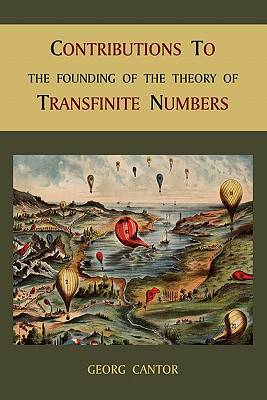
2010 Reprint of 1915 Edition. Georg Ferdinand Ludwig Philipp Cantor was a German mathematician, best known as the inventor of set theory, which has become a fundamental theory in mathematics. Cantor established the importance of one-to-one correspondence between sets, defined infinite and well-ordered sets, and proved that the real numbers are "more numerous" than the natural numbers. In fact, Cantor's theorem implies the existence of an "infinity of infinities". He defined the cardinal and ordinal numbers and their arithmetic. Cantor's work is of great philosophical interest, a fact of which he was well aware. In 1895-97 Cantor fully propounded his view of continuity and the infinite, including infinite ordinals and cardinals, in his best known work, Contributions to the Founding of the Theory of Transfinite Numbers . This work contains his conception of transfinite numbers, to which he was led by his demonstration that an infinite set may be placed in a one-to-one correspondence with one of its subsets.
Specificaties
Betrokkenen
- Auteur(s):
- Uitgeverij:
Inhoud
- Aantal bladzijden:
- 222
- Taal:
- Engels
Eigenschappen
- Productcode (EAN):
- 9781891396533
- Verschijningsdatum:
- 30/12/2010
- Uitvoering:
- Paperback
- Formaat:
- Trade paperback (VS)
- Afmetingen:
- 152 mm x 229 mm
- Gewicht:
- 331 g


Alleen bij Standaard Boekhandel
+ 35 punten op je klantenkaart van Standaard Boekhandel
Cadeau

AANGERADEN


Beoordelingen
We publiceren alleen reviews die voldoen aan de voorwaarden voor reviews. Bekijk onze voorwaarden voor reviews.