


- Afhalen na 1 uur in een winkel met voorraad
- Gratis thuislevering in België vanaf € 30
- Ruim aanbod met 7 miljoen producten
- Afhalen na 1 uur in een winkel met voorraad
- Gratis thuislevering in België vanaf € 30
- Ruim aanbod met 7 miljoen producten





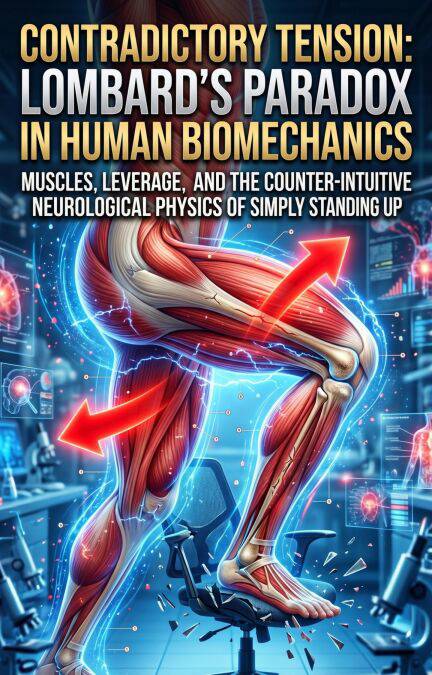
Contradictory Tension: Lombard's Paradox in Human Biomechanics E-BOOK
Muscles, Leverage, and the Counter-Intuitive Neurological Physics of Simply Standing Up
Olivia Smith
E-book | Engels
€ 4,99
+ 4 punten
Omschrijving
How is it physically possible for a human being to stand up from a seated position, given that the two major muscle groups required to perform the action actually pull the bones in completely opposite directions? This bizarre mechanical contradiction in human anatomy is known in kinesiology as Lombard's Paradox.
When you rise from a chair, you must extend both your hip and your knee. However, the rectus femoris (quadriceps) extends the knee but flexes the hip, while the hamstrings extend the hip but flex the knee. Logically, if both muscles fire at the same time, they should perfectly cancel each other out, locking your leg in a stiff, paralyzed spasm. Yet, we stand up effortlessly. The paradox is resolved by a brilliant evolutionary hack in our mechanical leverage: because the muscles have different "moment arms" (distances from the joint center) at the hip and knee, the extension force mathematically overrides the flexion force at both joints simultaneously.
This fascinating biomechanical manual dissects the hidden physics of everyday movement. It explores the complex neurological signaling required for muscular co-contraction, the evolutionary design of the human femur, and why understanding this paradox is crucial for physical therapy and athletic performance.
Appreciate the brilliant engineering of your own body. Lombard's Paradox proves that human movement is not just simple biology; it is a highly complex, flawlessly calculated symphony of physical leverage.
When you rise from a chair, you must extend both your hip and your knee. However, the rectus femoris (quadriceps) extends the knee but flexes the hip, while the hamstrings extend the hip but flex the knee. Logically, if both muscles fire at the same time, they should perfectly cancel each other out, locking your leg in a stiff, paralyzed spasm. Yet, we stand up effortlessly. The paradox is resolved by a brilliant evolutionary hack in our mechanical leverage: because the muscles have different "moment arms" (distances from the joint center) at the hip and knee, the extension force mathematically overrides the flexion force at both joints simultaneously.
This fascinating biomechanical manual dissects the hidden physics of everyday movement. It explores the complex neurological signaling required for muscular co-contraction, the evolutionary design of the human femur, and why understanding this paradox is crucial for physical therapy and athletic performance.
Appreciate the brilliant engineering of your own body. Lombard's Paradox proves that human movement is not just simple biology; it is a highly complex, flawlessly calculated symphony of physical leverage.
Specificaties
Betrokkenen
- Auteur(s):
- Uitgeverij:
Inhoud
- Aantal bladzijden:
- 155
- Taal:
- Engels
Eigenschappen
- Productcode (EAN):
- 9783565463008
- Verschijningsdatum:
- 26/05/2026
- Uitvoering:
- E-book
- Formaat:
- ePub


Alleen bij Standaard Boekhandel
+ 4 punten op je klantenkaart van Standaard Boekhandel
Cadeau

AANGERADEN


Beoordelingen
We publiceren alleen reviews die voldoen aan de voorwaarden voor reviews. Bekijk onze voorwaarden voor reviews.