


- Afhalen na 1 uur in een winkel met voorraad
- Gratis thuislevering in België vanaf € 30
- Ruim aanbod met 7 miljoen producten
- Afhalen na 1 uur in een winkel met voorraad
- Gratis thuislevering in België vanaf € 30
- Ruim aanbod met 7 miljoen producten





€ 29,00
+ 58 punten
Uitvoering
Omschrijving
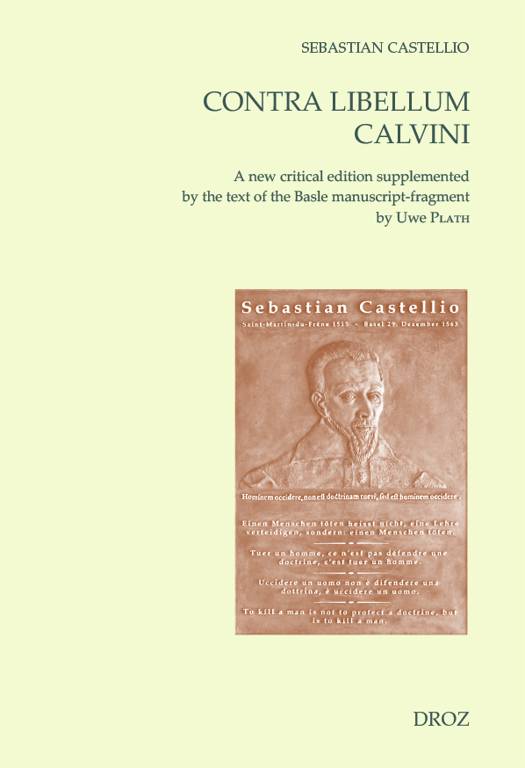
Sebastian Castellio's Contra libellum Calvini belongs – together with the De haereticis, an sint persequendi – to his most important contribution to the toleration controversy that began after the Spaniard Michael Servetus was arrested and burnt at the stake in Geneva for heresy. Castellio wrote this work in the summer 1554 in Basle as an answer to Calvin’s Defensio orthodoxae fidei.
It was written as a dialogue between Calvin and ""Vaticanus"" (Castellio). In this work we get to know the Basle humanist as an angry, passionate debater who attacks Calvin's faults and weaknesses, his theology and activity in Geneva with arguments full of irony and biting scorn. Here we find the famous sentence ""to kill a man is not to defend a doctrine, but is to kill a man"". This work was first published in 1612 in the Netherlands by the humanist Reinier Telle.
Uwe Plath’s critical edition is not only a reproduction of the Telle text, it also includes the text of the Basle Autograph- fragment and attempts to give a readable, error-free text, as close as possible to Castellio’s original.
It was written as a dialogue between Calvin and ""Vaticanus"" (Castellio). In this work we get to know the Basle humanist as an angry, passionate debater who attacks Calvin's faults and weaknesses, his theology and activity in Geneva with arguments full of irony and biting scorn. Here we find the famous sentence ""to kill a man is not to defend a doctrine, but is to kill a man"". This work was first published in 1612 in the Netherlands by the humanist Reinier Telle.
Uwe Plath’s critical edition is not only a reproduction of the Telle text, it also includes the text of the Basle Autograph- fragment and attempts to give a readable, error-free text, as close as possible to Castellio’s original.
Specificaties
Betrokkenen
- Auteur(s):
- Uitgeverij:
Inhoud
- Aantal bladzijden:
- 240
- Taal:
- Latijn, Engels
Eigenschappen
- Productcode (EAN):
- 9782600059763
- Verschijningsdatum:
- 31/10/2019
- Uitvoering:
- Paperback
- Afmetingen:
- 152 mm x 222 mm
- Gewicht:
- 400 g


Alleen bij Standaard Boekhandel
+ 58 punten op je klantenkaart van Standaard Boekhandel
Cadeau

AANGERADEN


Beoordelingen
We publiceren alleen reviews die voldoen aan de voorwaarden voor reviews. Bekijk onze voorwaarden voor reviews.