


- Afhalen na 1 uur in een winkel met voorraad
- Gratis thuislevering in België vanaf € 30
- Ruim aanbod met 7 miljoen producten
- Afhalen na 1 uur in een winkel met voorraad
- Gratis thuislevering in België vanaf € 30
- Ruim aanbod met 7 miljoen producten





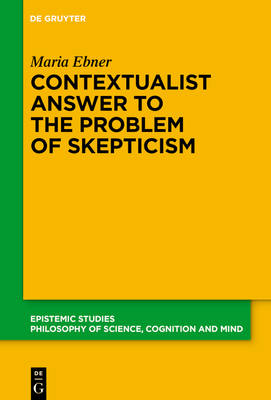
Contextualist Answer to the Problem of Skepticism
Maria Ebner
€ 103,95
+ 207 punten
Omschrijving
This book develops procedural contextualism, an original framework designed to strengthen the contextualist response to skepticism. At its core is the concept of procedure: community-sanctioned methods for justifying propositions. On this view, epistemic standards are deter-mined by the set of procedures recognized in a given context, offering a more precise account of how knowledge claims are assessed.
The first part of the book surveys existing contextualist approaches, focusing on the influential accounts of Lewis and DeRose. While these theories advanced the debate on knowledge attribu-tion, they face serious challenges. Chief among them is a persistent indeterminacy about how epistemic standards are fixed, as well as the difficulty of resolving conflicts between competing presupposed standards. Lewis's reliance on the rule of attention, for example, seems arbitrary in its priority over conservatism, while DeRose's account struggles with Gettier-style puzzles and other problematic scenarios. These shortcomings illustrate the need for a more robust model.
The second part introduces and develops procedural contextualism as such a model. By rooting epistemic standards in identifiable community procedures, this theory removes the arbitrariness that undermines earlier contextualist frameworks. It also allows for clearer evaluation of contex-tualist examples, distinguishing those that genuinely illustrate contextual variation from those that do not. The framework proves especially effective in addressing well-known epistemological cases such as the fake barns and lottery scenarios, where traditional contextualism falters.
The book further engages with prominent objections to epistemic contextualism, both semantic and epistemic in nature. It shows how many criticisms either rely on misunderstandings or can be met convincingly within the procedural contextualist framework. This dual function--critical and constructive--positions the theory as both a refinement of and an advance beyond earlier contextualist accounts.
Situated within the analytic tradition, with particular emphasis on linguistic analysis and clarity of thought, the book combines rigorous critique with theoretical innovation. It demonstrates how procedural contextualism not only clarifies the mechanics of epistemic standards but also en-hances the broader contextualist response to skepticism.
In offering this framework, the book provides an original contribution to contemporary episte-mology: a theory that is at once more determinate, more explanatory, and better equipped to engage with enduring philosophical puzzles.
Specificaties
Betrokkenen
- Auteur(s):
- Uitgeverij:
Inhoud
- Aantal bladzijden:
- 168
- Taal:
- Engels
- Reeks:
- Reeksnummer:
- nr. 57
Eigenschappen
- Productcode (EAN):
- 9783112232514
- Verschijningsdatum:
- 17/03/2026
- Uitvoering:
- Hardcover
- Formaat:
- Genaaid
- Afmetingen:
- 156 mm x 234 mm
- Gewicht:
- 417 g


Alleen bij Standaard Boekhandel
+ 207 punten op je klantenkaart van Standaard Boekhandel
Cadeau

AANGERADEN


Beoordelingen
We publiceren alleen reviews die voldoen aan de voorwaarden voor reviews. Bekijk onze voorwaarden voor reviews.