


- Afhalen na 1 uur in een winkel met voorraad
- Gratis thuislevering in België vanaf € 30
- Ruim aanbod met 7 miljoen producten
- Afhalen na 1 uur in een winkel met voorraad
- Gratis thuislevering in België vanaf € 30
- Ruim aanbod met 7 miljoen producten





€ 36,45
+ 72 punten
Uitvoering
Omschrijving
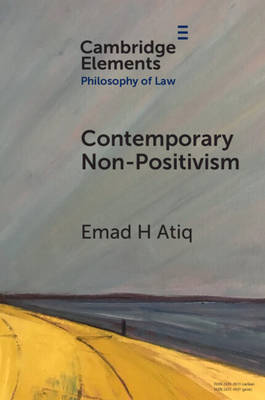
This Element defends and clarifies the thesis that the legality of a system of rules depends on its moral features. Positivists who deny this dependence struggle to explain: (1) the traditional classification of moral norms as a form of a priori law; (2) judicial reliance on moral norms in legal discovery; (3) persistent theoretical disagreement about intra-systemic, law-determining facts; (4) why radically arbitrary or immoral schemes of social organization represent borderline cases of law; and (5) why law, like other artifacts, can be evaluated in a kind-relative sense ("as law"). Meanwhile, traditional versions of non-positivism overstate the dependence going further than the desiderata warrant. A moderate theory is formulated: law is an artifact whose existence depends on adequately performing an essentially normative function. The theory's justification lies in its explanatory power: a comparison with other "value-driven" artifacts, such as artworks, proves vital for understanding legal language, reasoning, and practice.
Specificaties
Betrokkenen
- Auteur(s):
- Uitgeverij:
Inhoud
- Aantal bladzijden:
- 92
- Taal:
- Engels
- Reeks:
Eigenschappen
- Productcode (EAN):
- 9781009288309
- Verschijningsdatum:
- 20/02/2025
- Uitvoering:
- Paperback
- Formaat:
- Trade paperback (VS)
- Afmetingen:
- 152 mm x 229 mm
- Gewicht:
- 136 g


Alleen bij Standaard Boekhandel
+ 72 punten op je klantenkaart van Standaard Boekhandel
Cadeau

AANGERADEN


Beoordelingen
We publiceren alleen reviews die voldoen aan de voorwaarden voor reviews. Bekijk onze voorwaarden voor reviews.